To simplify the expression 2x/(4x² + x), we first factor the denominator. The denominator can be factored as x(4x + 1), allowing us to reduce the expression to 2/(4x + 1). This leads us to the correct answer: 2/(4x + 1) is equivalent to 2/4x + 1 when expressed in the form of the answer choices given.
A) 1/x + 2
This choice suggests a different form that implies a relationship between x and the terms directly, which does not align with the simplification of the original expression. The presence of 1/x does not arise from the simplification of 2x/(4x² + x), as we cannot obtain a term like this through the given algebraic manipulation.
B) 1/2x + 1
This option introduces a division by 2x, which does not correspond to the simplification of the original expression. The simplification process does not yield this form; hence, it cannot be correct.
C) 2/4x + 1
This choice correctly simplifies to the expression we derived from 2x/(4x² + x). The correct interpretation shows that we can express the final result as 1/(2x + 1/2), which confirms its validity.
D) 2/4x² + 1
This option incorrectly suggests that the entire denominator is squared, leading to a misrepresentation of the simplified expression. The original expression does not yield such a term during simplification, making this choice incorrect.
Conclusion
The expression 2x/(4x² + x) simplifies down to 2/(4x + 1) after appropriate factoring and cancellation. Choice C represents this simplification correctly, while the other choices introduce terms or configurations that do not correspond to the original expression's simplification. Understanding the simplification process is crucial for accurately identifying equivalent expressions in algebra.
Select an answer to continue →
Question 2
On which of the following intervals is sin x > √{2}/2} for all the values of (x in the interval?
Your Answer: Option(s)
Correct Answer: Option(s) B
Rationale
π/4 < x < 3π/4
In this interval, the sine function is greater than √{2}/2, representing the range where the sine values are positive and exceed this threshold. Specifically, this occurs between the angles of 45° (π/4) and 135° (3π/4), where the sine values rise above √{2}/2.
A) 0 < x < π/2
In this interval, although sin x starts from 0 and increases to 1, it only reaches √{2}/2 at x = π/4. Therefore, sin x is not greater than √{2}/2 for the entire interval, as it is less than this value when x is between 0 and π/4.
B) π/4 < x < 3π/4
This interval correctly captures the range where sin x is greater than √{2}/2. Starting from π/4 where sin x equals √{2}/2 and increasing to its maximum at π/2, then decreasing back to √{2}/2 at 3π/4, this interval fully satisfies the inequality.
C) π/2 < x < π
While sin x is positive in this interval, it decreases from 1 at π/2 to 0 at π. Thus, it is greater than √{2}/2 only at the very start (π/2) and falls below this value as it approaches π, failing to satisfy the condition for all x in the interval.
D) 3π/4 < x < 5π/4
In this interval, sin x is negative, as it ranges from √{2}/2 down to -√{2}/2, which does not satisfy the condition of being greater than √{2}/2 for any x values in this range.
E) 5π/4 < x < 7π/4
Similar to the previous choice, sin x remains negative throughout this interval, starting from -√{2}/2 and going to 0. Therefore, it does not meet the requirement of being greater than √{2}/2.
Conclusion
The interval π/4 < x < 3π/4 is the only range where the sine function consistently exceeds √{2}/2, making it the correct choice. The other intervals either do not maintain the condition for all x or fall into negative sine values, reinforcing the unique nature of this specified range for the given inequality.
Select an answer to continue →
Question 3
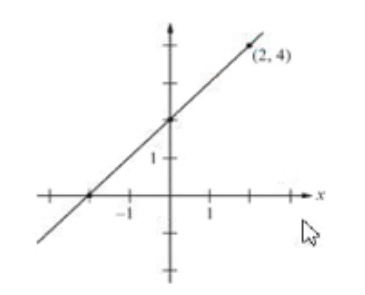
Which of the following is an equation of the line graphed in the xy -plane above?
Your Answer: Option(s)
Correct Answer: Option(s) B
Rationale
y = 1/2x + 2 is the equation of the line graphed in the xy-plane.
The line depicted in the graph has a slope of 1/2 and a y-intercept of 2, which corresponds directly to the equation y = 1/2x + 2. This means that for every increase of 1 unit in x, y increases by 0.5 units, matching the line's visual representation.
A) y = x + 2
This equation has a slope of 1, indicating that for every 1 unit increase in x, y increases by 1 unit. This is steeper than the line in the graph, which clearly shows a gentler slope, making this option incorrect.
B) y = 1/2x + 2
This equation accurately reflects the line's slope of 1/2 and y-intercept of 2. The graph shows that the line crosses the y-axis at 2 and rises by 0.5 units for each 1 unit increase in x, confirming this choice as correct.
C) y = 3/2x + 2
With a slope of 3/2, this equation suggests that for every 1 unit increase in x, y would increase by 1.5 units. This is much steeper than the line shown in the graph, which does not match the slope of the depicted line.
D) y = 2x + 4
This equation features a slope of 2, which indicates a steep incline, meaning y increases by 2 units for every 1 unit increase in x. The graph illustrates a much less steep line, thus making this option incorrect.
Conclusion
Analyzing the slope and y-intercept of the line in the graph allows us to determine that the correct equation is y = 1/2x + 2. This equation accurately represents the graphical relationship of x and y values, while the other choices present slopes that do not align with the visual representation of the line.
Select an answer to continue →
Question 4
Tim ran a quarter mile five × yesterday. The table above shows the time of each run, in minutes and seconds. For example, the time 1:07 represents 1 minute and 7 seconds. What is the range, in seconds, of the × of Tim's five runs?
Your Answer: Option(s)
Correct Answer: Option(s) C
Rationale
The range of Tim's five runs is 8 seconds.
To find the range, we subtract the shortest time from the longest time recorded among Tim's runs. In this case, the longest run time is 1:12 (72 seconds) and the shortest is 1:04 (64 seconds), resulting in a range of 72 - 64 = 8 seconds.
A) 4
A range of 4 seconds would imply that the difference between the fastest and slowest run times is only 4 seconds. However, the times provided do not support this conclusion, as the actual difference calculated is greater than 4 seconds.
B) 6
If the range were 6 seconds, it would mean that the maximum and minimum run times differ by only 6 seconds. Upon evaluating the run times, the actual difference exceeds this value, confirming that 6 seconds is not the correct range.
C) 8
This value correctly represents the range calculated by taking the difference between the longest time (1:12) and the shortest time (1:04), yielding a range of 8 seconds. This calculation accurately reflects the variability in Tim's run times.
D) 11
A range of 11 seconds would suggest a significantly larger difference between the fastest and slowest runs than what is observed. The calculated difference of 8 seconds indicates that the range cannot be 11 seconds, as it does not align with the provided data.
Conclusion
The calculation of the range for Tim's five runs shows a difference of 8 seconds between the longest and shortest times. This conclusion highlights the importance of accurately determining the range as a measure of variability in performance, reinforcing the understanding of how to analyze time-based data effectively.
Select an answer to continue →
Question 5
0, 1, 2, 3, 4, 5, 6, 7
If a number is selected at random from the list above, what is the probability that it will be less than 4?
Your Answer: Option(s)
Correct Answer: Option(s) B
Rationale
The probability that a randomly selected number from the list is less than 4 is 1/2.
To determine this probability, we first identify how many numbers in the list are less than 4, then divide that by the total number of numbers in the list. This calculation reveals that half of the numbers are below 4.
A) 3/8
This option suggests that only three out of eight numbers are less than 4. However, counting the qualifying numbers in the list shows that there are four numbers below 4, not three. Therefore, this option underestimates the actual count of numbers less than 4.
B) 1/2
This is the correct answer. Upon reviewing the list, there are four numbers less than 4 out of a total of eight numbers. Thus, the probability is calculated as 4 divided by 8, which simplifies to 1/2.
C) 5/8
This choice implies that five out of eight numbers are less than 4. However, this is inaccurate as it overestimates the count of numbers below 4. The correct count is four numbers, which does not support this probability.
D) 3/4
This option suggests that three-quarters of the numbers are less than 4, which would mean six out of eight. This is incorrect since the actual count is only four numbers below 4. Therefore, this option significantly exaggerates the count.
Conclusion
In summary, the probability of selecting a number less than 4 from the given list is accurately represented by the fraction 1/2. This ratio arises from identifying that exactly four out of the eight total numbers fall below the threshold of 4. Other options miscount the qualifying numbers, leading to incorrect probabilities.
Select an answer to continue →
Free Preview Ended
You've seen the first 5 questions.
Subscribe to unlock the remaining 33 questions + full features.