Rationale
Circular-flow model
The circular-flow model illustrates the economy's flow of goods, services, and factors of production between households and firms. In this model, households provide labor and other resources to firms, which in turn supply goods and services to households, creating a continuous loop that highlights the interdependence of these two sectors.
A) Circular-flow model
This model effectively represents the interactions between households and firms, showcasing how households supply factors of production—such as labor, land, and capital—while firms provide goods and services in return. This mutual exchange encapsulates the fundamental dynamics of economic activity, making it a vital concept in understanding how an economy operates.
B) Crowding-out effect
The crowding-out effect refers to a situation in which increased government spending leads to a reduction in private sector spending and investment. This concept does not illustrate the flow of factors of production and goods between households and firms, but rather addresses the impact of government intervention on the economy, making it irrelevant to the question at hand.
C) Comparative-advantage theory
Comparative advantage theory focuses on the benefits of trade and specialization between different entities, emphasizing how entities can gain from trade by specializing in the production of goods for which they hold a relative efficiency. While it explains trade dynamics, it does not illustrate the direct interaction between households and firms regarding the supply of factors and goods.
D) Production-possibilities curve
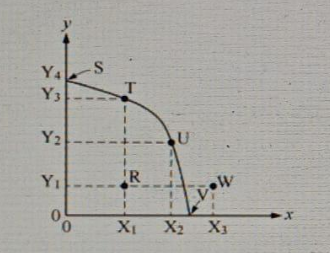
The production-possibilities curve (PPC) represents the maximum output combinations of two goods that an economy can achieve, given available resources and technology. Although it reflects opportunity costs and resource allocation, it does not depict the flow of factors of production and goods/services between households and firms, making it unsuitable for this question.
Conclusion
The circular-flow model is the only choice that effectively captures the relationship between households supplying factors of production and firms providing goods and services. This model underscores the interdependent nature of economic agents, facilitating a comprehensive understanding of how resources and outputs circulate within an economy. Other options focus on different economic principles and do not address the specific interactions outlined in the question.