
Multiplying a certain nonzero number by 0.01 gives the same result as dividing the number by
Rationale
Multiplying a certain nonzero number by 0.01 gives the same result as dividing the number by 100.
When you multiply a number by 0.01 and divide the same number by 100, the results will be the same. This is because 0.01 is the decimal equivalent of 1/100, which means that multiplying by 0.01 is the same as dividing by 100.
A) 100
Dividing a number by 100 is indeed equivalent to multiplying it by 0.01. As stated previously, 0.01 is the decimal representation of the fraction 1/100. Hence, these two operations are mathematically the same and will yield the same result.
B) 10
Dividing a number by 10 is not equivalent to multiplying it by 0.01. It would be equivalent to multiplying the number by 0.1, not 0.01. Therefore, this option is incorrect.
C) 1/10
Dividing a number by 1/10 is equivalent to multiplying the number by 10, not 0.01. This is because dividing by a fraction is the same as multiplying by its reciprocal. Hence, this choice is not correct.
D) 1/100
Dividing a number by 1/100 is equivalent to multiplying the number by 100, not 0.01. Similar to option C, dividing by a fraction is the same as multiplying by its reciprocal. Therefore, this choice is incorrect.
Conclusion
The mathematical operations of multiplying by a certain decimal number and dividing by its reciprocal fraction yield the same result. In this case, multiplying by 0.01 is the same as dividing by 100. All other choices—10, 1/10, and 1/100—do not represent the equivalent mathematical operation and hence are incorrect.
Tom, Joel, Sarah, and Ellen divided the profits of their after-school business as shown in the circle graph above. If Tom's share of the profits was $492, what was Ellen's share?
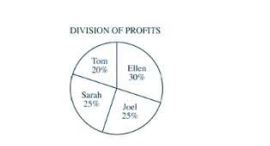
Rationale
Ellen's share of the profits was $2,460.
The question provides the information that Tom's share was $492. The circle graph shows that Tom's share was 20% of the total profits. So, to find the total profits, we can calculate $492 divided by 20% (or 0.2). Once we have the total profit, we can then calculate Ellen's share, which was 100% of the profits, by multiplying the total profit by 100% (or 1.0).
A) $2,460
This is the correct answer. Given that Tom's share was $492 and it represented 20% of the total profits, we can calculate the total profits as $492 / 0.2 = $2,460. Since the graph shows that Ellen received 100% of the profits, her share would be $2,460 * 1.0 = $2,460.
B) $615
This choice might be selected if one incorrectly calculated Ellen's share as 25% of the total profits. However, since the graph shows that Ellen received 100% of the profits, her share should be calculated as the total profits, not 25% of them.
C) $738
This choice might be selected if one incorrectly calculated Ellen's share as 30% of the total profits. However, since the graph shows that Ellen received 100% of the profits, her share should be calculated as the total profits, not 30% of them.
D) $820
This choice might be selected if one incorrectly calculated Ellen's share as 40% of the total profits. However, since the graph shows that Ellen received 100% of the profits, her share should be calculated as the total profits, not 40% of them.
Conclusion
In conclusion, by knowing that Tom's share of $492 represented 20% of the total profits, we were able to calculate the total profits. As the graph indicated that Ellen received 100% of these profits, it was then straightforward to determine that Ellen's share was $2,460. Misinterpretations of the graph or miscalculations could have led to the selection of the other options, but these do not accurately reflect the information provided in the question.
Linda has borrowed 8 more books than Susan from the school library. Richard has borrowed half as many books as Linda has. If Richard has borrowed 17 books from the library, how many books has Susan borrowed?
Rationale
Susan has borrowed 26 books from the school library.
This is determined by first understanding that Richard has borrowed half as many books as Linda. This means Linda has borrowed twice as many books as Richard, i.e., 34 books. We are also told that Linda has borrowed 8 more books than Susan, so subtracting 8 from Linda's total gives us the number of books Susan has borrowed.
A) 25
This choice might result from a small calculation error when subtracting the 8 books that Linda has borrowed more than Susan. If Linda has 34 books and we subtract 8, the correct answer is 26, not 25.
B) 26
This is the correct answer. Since Linda has borrowed 8 more books than Susan, and Linda has borrowed 34 books, we subtract 8 from 34 to find that Susan has borrowed 26 books.
C) 34
This is the number of books Linda has borrowed, not Susan. As per the information given, Linda has borrowed 8 books more than Susan, which means Susan has borrowed less than 34 books.
D) 42
This choice seems to result from a misunderstanding of the relationships between the numbers. There's no information in the question that would lead to this number.
Conclusion
The problem requires understanding the relationship between the number of books each person has borrowed. Since Richard has borrowed 17 books and Richard's number is half of Linda's, Linda has borrowed 34 books. Since Linda has borrowed 8 more books than Susan, subtracting 8 from Linda's total gives us the number of books Susan has borrowed, which is 26.
Harriet took 48 minutes to ride her bike the distance from her house to the town library. If she rode at a constant rate, what fraction of the total distance did she ride in the first 12 minutes?
Rationale
A) 1/4 is the correct answer.
Harriet's bike ride took a total of 48 minutes. If we want to find out what fraction of the total distance she covered in the first 12 minutes, we simply divide the 12 minutes by the total time of 48 minutes. This results in a fraction of 1/4, which means Harriet rode a quarter of the total distance in the first 12 minutes.
B) 1/3
This answer would be correct if Harriet had ridden for 16 minutes, not 12, because 16 minutes is one-third of 48 minutes. However, the question specifies that we are looking for the fraction of the total distance she rode in the first 12 minutes, which is only a quarter of the total time.
C) 1/2
This is not correct because 1/2 of 48 minutes is 24 minutes. The question asks for the fraction of the total distance she rode in the first 12 minutes. Therefore, this option overestimates the proportion of the journey completed in the first 12 minutes.
D) 3/4
This option would be correct if Harriet had ridden for 36 minutes because 36 minutes is three-quarters of 48 minutes. However, the question specifies that we want to know the fraction of distance she rode in the first 12 minutes. Hence, this answer significantly overestimates the proportion of the journey completed in the first 12 minutes.
Conclusion
The question asks for the fraction of the total distance Harriet rode in the first 12 minutes. Given that the total duration of her ride was 48 minutes, the fraction of the total distance she rode in the first 12 minutes is 12/48, simplifying to 1/4. Other options represent fractions of the total time that do not correspond to the first 12 minutes of her ride.
Which of the following integers, when rounded to the nearest thousand, results in 2,000?
Rationale
1,601, when rounded to the nearest thousand, results in 2,000.
When rounding to the nearest thousand, any integer from 1,500 to 2,499 would be rounded to 2,000. This is because the halfway point between 1,000 and 2,000 is 1,500, and the halfway point between 2,000 and 3,000 is 2,500. Any number equal to or above the halfway point is rounded up, and any number below the halfway point is rounded down.
A) 2,567
The integer 2,567, when rounded to the nearest thousand, results in 3,000 and not 2,000. This is because 2,567 is above the halfway point of 2,500 between 2,000 and 3,000.
B) 1,499
The integer 1,499, when rounded to the nearest thousand, results in 1,000 and not 2,000. This is because 1,499 is below the halfway point of 1,500 between 1,000 and 2,000.
C) 1,097
The integer 1,097, when rounded to the nearest thousand, results in 1,000 and not 2,000. This is because 1,097 is below the halfway point of 1,500 between 1,000 and 2,000.
D) 1,601
The integer 1,601, when rounded to the nearest thousand, results in 2,000. This is because 1,601 is above the halfway point of 1,500 between 1,000 and 2,000.
Conclusion
When rounding to the nearest thousand, any number from 1,500 to 2,499 will be rounded to 2,000. In this set of choices, only the integer 1,601 falls within that range and thus is the only number that will be rounded to 2,000. The other choices (2,567, 1,499, and 1,097) will be rounded to 3,000 and 1,000, respectively, as they fall outside the 1,500 to 2,499 range.
Free Preview Ended
You've seen the first 5 questions.
Subscribe to unlock the remaining 14 questions + full features.
0/0 correct
19 left
You are leaving this quiz
What would you like to do with your progress?
You're in the middle of a quiz
What would you like to do before switching?
Report an Issue
Help us improve by flagging this content.
Rate this Practice Test
How helpful was this material?