
Maria walks x yards in 15 minutes. If she continues to walk at the same average rate, how many more yards will she walk in the next 7 minutes?
Rationale
Maria will walk 7x/15 yards in the next 7 minutes.
To determine how many more yards Maria will walk in 7 minutes, we first calculate her walking rate, which is x yards in 15 minutes. By finding her average speed, we can then project the distance she covers in the additional time.
A) 15x/7
This choice incorrectly represents the distance covered in 7 minutes. The expression suggests a calculation based on a fixed fraction of the total distance walked in a different context rather than the average rate. It does not take into account the correct time interval or the relationship between distance, rate, and time.
B) (x/15)+7
This option inaccurately adds a constant to the average rate, implying that Maria walks an extra 7 yards on top of her actual speed. The formula does not correctly reflect the relationship among distance, time, and rate, leading to a nonsensical result that does not represent her walking distance in the specified time frame.
C) (x+7)/15
This choice implies an incorrect average speed calculation by summing the total distance with 7 yards and then dividing by 15. This approach fails to represent the time correctly and distorts the relationship between distance and rate, leading to an erroneous average speed rather than the actual distance covered in the next 7 minutes.
D) 7x/15
This choice accurately calculates the distance Maria will walk in 7 minutes. By first determining her speed as x/15 yards per minute, we multiply this rate by 7 minutes, leading to the correct formula of (x/15) * 7 = 7x/15 yards.
Conclusion
Maria's walking distance in 7 minutes can be accurately calculated using her established average rate of x yards in 15 minutes. The correct choice, 7x/15, derives from multiplying her speed by the time interval, ensuring the calculation aligns with the principles of distance, rate, and time. The other options misinterpret these relationships, leading to incorrect conclusions.
Which of the following is equal to |7 - 5|?
Rationale
|5 - 7| is equal to |7 - 5|.
The absolute value of a number represents its distance from zero, regardless of direction. Since |7 - 5| simplifies to |2|, and |5 - 7| simplifies to |-2|, both expressions yield the same result of 2, illustrating the property of absolute values being equal for both orders of subtraction.
A) |7| + |-5|
This choice equals |7| + |-5| = 7 + 5 = 12. The absolute values of 7 and -5 are added rather than computed as a difference, resulting in a value far greater than |7 - 5|. Therefore, this expression does not represent the same quantity.
B) |5| - |7|
This option simplifies to |5| - |7| = 5 - 7 = -2. The absolute value of this expression is 2, but it does not reflect the operation of subtraction in the original question, which measures the distance between the two numbers rather than their difference.
D) |-7 + (-5)|
This choice results in |-7 - 5| = |-12| = 12. This expression calculates the absolute value of the sum of -7 and -5, which does not relate to the subtraction of 5 from 7, thus yielding a value that is not equal to |7 - 5|.
Conclusion
The absolute value operation emphasizes the distance between two numbers, leading to the equality |7 - 5| = |5 - 7|. Among the choices provided, only C) |5 - 7| properly reflects this property, confirming that both expressions yield the same result of 2. The other options do not adhere to the subtraction mechanism and instead yield different values, demonstrating how absolute values can vary depending on the mathematical operation performed.
If the average (arithmetic mean) of g and 100 is 75, what is the value of g + 100?
Rationale
g + 100 equals 150.
To find the value of g + 100, we first need to determine g using the information provided about the average. The average of g and 100 is calculated as (g + 100) / 2 = 75. By solving for g, we can then find the required sum.
A) 50
This choice suggests that g + 100 equals 50, which would imply that g is -50. However, substituting g = -50 into the average formula yields an average of (-50 + 100) / 2 = 25, which does not satisfy the condition that the average is 75.
B) 125
If g + 100 equals 125, then g must be 25. However, using this value in the average formula gives (25 + 100) / 2 = 62.5, which is also not equal to 75, thus making this choice incorrect.
C) 150
To find g + 100, we know the average of g and 100 is 75, leading to the equation (g + 100) / 2 = 75. Multiplying both sides by 2 gives g + 100 = 150. This is the correct answer.
D) 175
This option implies that g + 100 equals 175, which would mean g is 75. Substituting this back into the average formula results in (75 + 100) / 2 = 87.5, which does not satisfy the condition that the average is 75.
Conclusion
To solve for g + 100, we use the average condition to derive that g + 100 equals 150. The other choices do not satisfy the average requirement, confirming that the only valid solution is indeed 150. This reinforces the importance of correctly interpreting average values in algebraic equations.
Which of the following is equivalent to the inequality above?
Rationale
x < 4.
This inequality states that the variable x must be less than 4, representing a range of values that x can take. Any value of x that is less than 4 satisfies this condition, thus making it the equivalent statement to the original inequality presented.
A) x > -4
This statement implies that x can be any value greater than -4, which includes values that are greater than 4. Therefore, it does not appropriately represent the original inequality where x must be less than 4; thus, it is incorrect.
B) x > -2
Similar to choice A, this option indicates that x can take on any value greater than -2. This range includes values greater than 4, again failing to meet the original condition of x being less than 4. Therefore, it does not correlate with the given inequality.
C) x < 2
This choice suggests that x must be less than 2. While this is a subset of values less than 4, it does not encompass all possible values that satisfy the original inequality. Thus, it is too restrictive and does not represent the full range defined by x < 4.
D) x < 4
This option accurately reflects the requirement that x must be less than 4, matching the original inequality perfectly. It includes all values that satisfy the condition, thereby making it the correct equivalent statement.
Conclusion
The correct interpretation of the inequality is represented by the statement x < 4, indicating that x can take any value below 4. The other options provide ranges that either exceed or do not fully capture the constraints set by the original inequality, thereby confirming that D is the only valid equivalent choice.
In the xy-plane above, line k (not shown) is perpendicular to line l. What is the slope of line k?
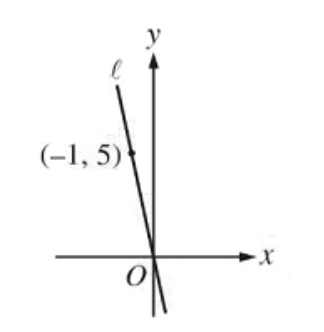
Rationale
The slope of line k is -5.
Since line k is perpendicular to line l, which has a slope of 5, the slope of line k can be found using the negative reciprocal of the slope of line l. The negative reciprocal of 5 is -1/5, which can be expressed as -0.2.
A) 5
This choice represents the slope of line l, not line k. Since line k is perpendicular to line l, it cannot have the same slope. Instead, the slope of line k must be the negative reciprocal of 5, making this option incorrect.
B) 01-May
This choice is a nonsensical value in the context of slope and does not represent any valid numerical slope. Slopes are numerical values that describe the steepness of a line, and this option does not apply to the question at all.
C) -0.2
This choice accurately represents the slope of line k, which is the negative reciprocal of the slope of line l (5). Since the negative reciprocal of 5 is -1/5, this value is equivalent to -0.2, confirming that this is the correct answer.
D) -5
This choice suggests a slope of -5, which is incorrect. The negative reciprocal of 5 is -1/5, not -5. Thus, the slope of line k cannot be -5 as it would not satisfy the condition of being perpendicular to line l.
Conclusion
In summary, the slope of line k, being perpendicular to line l with a slope of 5, is determined to be -0.2. The negative reciprocal relationship between the slopes of two perpendicular lines is crucial in identifying their corresponding slopes. Thus, -0.2 is the only valid slope for line k among the provided choices.
Free Preview Ended
You've seen the first 5 questions.
Subscribe to unlock the remaining 15 questions + full features.
0/0 correct
20 left
You are leaving this quiz
What would you like to do with your progress?
You're in the middle of a quiz
What would you like to do before switching?
Report an Issue
Help us improve by flagging this content.
Rate this Practice Test
How helpful was this material?