
If 4 is x percent of 16, what is x?
Rationale
The value of x is 25.
This is because when 4 is expressed as a percentage of 16, it is 25%. This is calculated by dividing 4 by 16 and then multiplying by 100.
A) 1/4
1/4 is the fraction equivalent when 4 is divided by 16, but not the percentage. To convert a fraction to a percentage, it needs to be multiplied by 100.
B) 4
The number 4 is not the percentage of 4 out of 16. It is the number being expressed as a percentage of 16. The actual percentage is obtained by dividing 4 by 16 and then multiplying by 100.
C) 16
16 is the total or the whole that 4 is a percentage of. It is not the percentage value itself. The percentage is calculated by dividing 4 by 16 and then multiplying by 100.
D) 25
25 is the correct answer, as it represents the percentage value when 4 is expressed as a percentage of 16. This is calculated by dividing 4 by 16, which gives 0.25, and then multiplying by 100 to convert it to a percentage.
Conclusion
When finding a percentage, the value being expressed as a percentage is divided by the total and then multiplied by 100. In this case, 4 is 25% of 16, therefore the value of x is 25. Choices A, B, and C are incorrect because they represent the fraction equivalent, the value being expressed as a percentage, and the total respectively, not the percentage itself.
Marisol has 5 × as many books as Jerry. Jerry has 15 books. How many books does Marisol have?
Rationale
Marisol has 75 books.
Given that Marisol has 5 times as many books as Jerry, and Jerry has 15 books, you can find out how many books Marisol has by multiplying Jerry's number of books by 5.
A) 10
This option is incorrect because it is less than the number of books Jerry has. Since Marisol has more books than Jerry, her total number of books should be greater than 15.
B) 20
This option is incorrect as it represents Jerry's number of books multiplied by approximately 1.3. Since Marisol has 5 times as many books as Jerry, her total should be 15 times 5.
C) 75
This option is correct as it is the result of multiplying Jerry's 15 books by 5. This is consistent with the statement that Marisol has 5 times as many books as Jerry.
D) 225
This option is incorrect because it represents Jerry's number of books multiplied by 15. The problem statement indicates that Marisol has 5 times as many books as Jerry, not 15 times.
Conclusion
Given that Marisol has 5 times as many books as Jerry, and that Jerry has 15 books, you can calculate the number of books Marisol has by multiplying 15 by 5. This results in 75 books, which is consistent with the information provided in the question. The other options represent incorrect calculations based on the number of books Jerry has.
Fred worked 39.5 hours last week. Alice worked 6.75 fewer hours than Fred. How many hours did Alice work?
Rationale
Alice worked 33.75 hours.
Fred worked 39.5 hours and Alice worked 6.75 fewer hours than Fred. Therefore, Alice worked 39.5 - 6.75 = 33.75 hours.
A) 33.75 HOURS
This is the correct answer. Alice worked 6.75 hours less than Fred, who worked 39.5 hours. The difference between these two times gives us the total hours Alice worked, which is 33.75 hours.
B) 33.25 HOURS
This option is incorrect because it is less than the actual number of hours Alice worked. If Alice had worked 33.25 hours, that would mean she worked 6.25 hours less than Fred, not 6.75 hours less.
C) 33.35 HOURS
This option is incorrect because it does not accurately reflect the number of hours Alice worked. If Alice had worked 33.35 hours, she would have worked 6.15 hours less than Fred, which is not the case.
D) 33.85 HOURS
This option is also incorrect. If Alice had worked 33.85 hours, she would have worked 5.65 hours less than Fred, not 6.75 hours less.
Conclusion
The correct answer is 33.75 hours. This is calculated by subtracting the difference in the number of hours that Alice worked from Fred's hours. The other options are incorrect because they do not accurately reflect the difference in hours between Fred and Alice's working time.
What is the product of 2,2/3 and 3,3/8?
Rationale
The product of 2,2/3 and 3,3/8 is 9.
To arrive at this result, we first convert each mixed number to an improper fraction: 2,2/3 becomes 8/3, and 3,3/8 becomes 27/8. We then multiply these fractions together and simplify the resulting fraction, which yields the number 9.
A) 5,5/11
This is incorrect. Multiplying 2,2/3 by 3,3/8 does not result in the mixed number 5,5/11. When each mixed number is converted to an improper fraction and multiplied together, the result is 72/8, or 9, not 5,5/11.
B) 6,1/24
This is incorrect. Multiplying 2,2/3 by 3,3/8 does not result in the mixed number 6,1/24. When each mixed number is converted to an improper fraction and multiplied together, the result is 72/8, or 9, not 6,1/24.
C) 7
This is incorrect. Multiplying 2,2/3 by 3,3/8 does not result in 7. When each mixed number is converted to an improper fraction and multiplied together, the result is 72/8, or 9, not 7.
D) 9
This is the correct result. When 2,2/3 and 3,3/8 are converted to improper fractions, they become 8/3 and 27/8 respectively. Multiplying these together yields 72/8, which simplifies to 9.
Conclusion
The product of the mixed numbers 2,2/3 and 3,3/8 is 9. The incorrect answers reflect either incorrect conversion of the mixed numbers to improper fractions, incorrect multiplication of the fractions, or incorrect simplification of the resulting fraction. Understanding the process of converting mixed numbers to improper fractions, correctly multiplying fractions, and simplifying the result is crucial to correctly solving this type of problem.
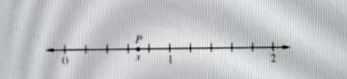
The coordinate of pointP on the number line above is x. The value of 10x is between
Rationale
The value of 10x is between 4 and 6.
The original question asks for the range of values of 10x based on the position of point P on the number line. If the value of 10x is between 4 and 6, it means that the value of x is between 0.4 and 0.6 on the number line.
A) 1 and 4
This option would imply that the value of x is between 0.1 and 0.4. However, this does not match the position of point P on the number line as shown in the question. Hence, this choice is incorrect.
B) 4 and 6
This option suggests that the value of x lies between 0.4 and 0.6. This is consistent with the position of point P on the number line. Therefore, this choice is the correct answer.
C) 6 and 8
If 10x was between 6 and 8, then x would be between 0.6 and 0.8. This range does not correspond with the position of point P on the number line. Therefore, this choice is not correct.
D) 8 and 12
This option would indicate that the value of x is between 0.8 and 1.2. However, this does not align with the position of point P on the number line as shown in the question. Hence, this choice is incorrect.
Conclusion
The value of x is determined by the position of point P on the number line. By multiplying x by 10, we can find the range of values that 10x can take. Based on the position of point P, the value of 10x falls between 4 and 6, which implies that x is between 0.4 and 0.6. The other choices do not match with the position of point P, making them incorrect. Therefore, the correct answer is 'B) 4 and 6'.
Free Preview Ended
You've seen the first 5 questions.
Subscribe to unlock the remaining 13 questions + full features.
0/0 correct
18 left
You are leaving this quiz
What would you like to do with your progress?
You're in the middle of a quiz
What would you like to do before switching?
Report an Issue
Help us improve by flagging this content.
Rate this Practice Test
How helpful was this material?