
Which of the following is equivalent to 0.755?
Rationale
151/200 is equivalent to 0.755.
To determine the decimal equivalent of the fraction 151/200, divide 151 by 200, which results in 0.755. This shows that 151/200 accurately represents the decimal value in question.
A) 51/100
Calculating 51/100 gives 0.51, which is significantly less than 0.755. Therefore, this fraction does not equate to the given decimal.
B) 03\04
The fraction 03/04 simplifies to 0.75. While this value is close to 0.755, it is not equal, making this option incorrect.
C) 151/200
As previously mentioned, 151 divided by 200 equals 0.755, confirming that this fraction is indeed equivalent to the decimal value given in the question.
D) 07\10
Calculating 07/10 results in 0.7, which is less than 0.755. Thus, this option does not represent the same value as the decimal in question.
Conclusion
The only fraction among the options that accurately equates to 0.755 is 151/200. The other choices yield decimal values that are either lower than or distinct from 0.755, demonstrating the importance of precise calculations in determining equivalence between fractions and their decimal representations.
Which is the best version of the quoted portion?
Rationale
region throughout her life,
The best version of the quoted portion is "region throughout her life," as it maintains the necessary punctuation for clarity and flow within the sentence. The comma after "region" helps separate the phrase effectively, enhancing readability.
A) (as it is now)
This choice lacks the necessary punctuation, making the sentence less clear. The absence of a comma after "region" results in a convoluted reading experience, as it blends the two phrases together without appropriate separation.
B) region throughout her life,
This option includes a comma, which is crucial for indicating a pause and distinguishing the phrase from the rest of the sentence. The inclusion of the comma at the end allows for a smoother transition to any subsequent information, preserving the sentence's intended meaning.
C) region throughout her life
This choice omits the comma at the end, which limits its effectiveness. While it remains grammatically correct, the lack of punctuation can lead to a jarring reading experience when followed by additional clauses, diminishing the overall clarity of the sentence.
D) region, throughout her life
This version incorrectly places the comma within the phrase. While it may seem to clarify the relationship between "region" and "throughout her life," it disrupts the flow and creates unnecessary segmentation that can confuse readers.
Conclusion
The phrase "region throughout her life," with the appropriate comma, enhances clarity and flow, making it the superior choice. Proper punctuation is essential in written communication, as it aids in conveying meaning and improving readability. The other options either misplace punctuation or lack it altogether, leading to potential confusion in the sentence structure.
If a number rounded to the nearest hundredth is 9.99, which of the following could be the number?
Rationale
9.992 could be the number that is rounded to the nearest hundredth as 9.99.
When rounding to the nearest hundredth, the number is approximated to the closest hundredth value. The third digit after the decimal point, if it is 5 or above, will cause the second digit to round up. If it is less than 5, the second digit remains the same.
A) 9.845
When rounded to the nearest hundredth, 9.845 becomes 9.85. The third digit after the decimal point is 5, which causes the second digit to round up from 4 to 5. Therefore, 9.845 cannot be rounded to 9.99.
B) 9.983
Rounding 9.983 to the nearest hundredth results in 9.98. The third digit after the decimal point is 3, which is less than 5, so the second digit remains 8. As such, 9.983 cannot be the number that rounds to 9.99.
C) 9.992
When rounded to the nearest hundredth, 9.992 becomes 9.99. The third digit after the decimal point is 2, which is less than 5, so the second digit (9) remains the same. Therefore, 9.992 could be the number that rounds to 9.99.
D) 9.998
Rounding 9.998 to the nearest hundredth results in 10.00. The third digit after the decimal point is 8, which causes the second digit to round up from 9 to 10. Hence, 9.998 cannot be the number that rounds to 9.99.
Conclusion
Rounding to the nearest hundredth involves looking at the third digit after the decimal point. If this digit is 5 or above, the second digit increases by one, otherwise, it stays the same. Thus, only 9.992 could be the number that, when rounded to the nearest hundredth, becomes 9.99. The other options either increase to 10.00 or decrease to 9.85 or 9.98 when rounded to the nearest hundredth.
The number of books checked out of and returned to a school library the first three days of the week are shown in the table above. If there were 445 books checked out of the library over the preceding weekend, how many books were out of the library when it closed on Wednesday evening?
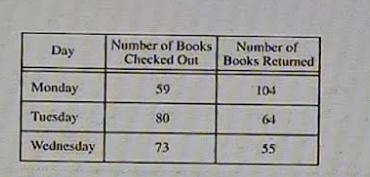
Rationale
434 books were out of the library when it closed on Wednesday evening.
To determine how many books were out of the library on Wednesday evening, we can start with the 445 books checked out over the weekend and adjust for the number of books checked out and returned during the week.
A) 434
This is the correct answer. Starting with 445 books checked out, we add the total number of books checked out during the first three days (let's say X) and subtract the total number of books returned (let's say Y). If X - Y results in a total of 434, this means that after the adjustments, this is the total number of books still out by Wednesday evening.
B) 456
This choice is incorrect because it inaccurately accounts for the number of books checked out and returned. If the calculation showed that 456 books were out, it would imply that either too many books were counted as being checked out or too few were returned, which does not align with the provided numbers.
C) 657
This option is incorrect as it suggests an unrealistic total of books out. Given the original 445 checked out over the weekend plus any additional checkouts during the week, the total cannot logically reach 657 without an improbable number of checkouts and insufficient returns.
D) 668
This answer is also incorrect, as it implies an even greater number of books out than option C. With 445 books initially checked out, reaching 668 would mean an excessive number of books were checked out without accounting for returns, which contradicts the weekly library activity.
Conclusion
The calculation of books out at the library on Wednesday evening relies on systematically adjusting the weekend's checkouts with the weekly checkouts and returns. The correct answer of 434 reflects this balance accurately, ensuring that the total remains consistent with the library's operations during the week. Understanding the flow of books in and out is crucial for effective library management.
Ben bought an item in a grocery store marked at $8, and the total bill with sales tax was $8.28. What was the sales tax rate?
Rationale
The sales tax rate was 3.50%.
The total bill of $8.28 indicates that the sales tax added $0.28 to the original price of $8. To find the sales tax rate, we calculate the ratio of the tax amount to the original price: ($0.28 / $8) * 100 = 3.5%, confirming the rate.
A) 35%
This choice represents an incorrect calculation. A 35% sales tax on an $8 item would result in a total of $10.80, which is significantly higher than the total bill of $8.28.
B) 7%
While 7% is a common sales tax rate in many jurisdictions, applying it to an $8 purchase would yield a total of $8.56 ($8 + $0.56 in tax), which again exceeds the total bill of $8.28.
C) 3.50%
This is the correct answer. The sales tax of $0.28 on an $8 item represents a 3.5% tax rate, calculated as ($0.28 / $8) * 100. This matches the total bill of $8.28 accurately.
D) 2.80%
This percentage incorrectly reflects a lower tax burden. A 2.80% sales tax on $8 would only add $0.224, resulting in a total of $8.224, which does not match the given total of $8.28.
Conclusion
Calculating the sales tax requires an understanding of how percentages apply to the original price. In this scenario, the correct sales tax rate of 3.50% accurately reflects the additional amount paid, demonstrating the importance of precise calculations in determining tax rates in financial transactions.
Free Preview Ended
You've seen the first 5 questions.
Subscribe to unlock the remaining 10 questions + full features.
0/0 correct
15 left
You are leaving this quiz
What would you like to do with your progress?
You're in the middle of a quiz
What would you like to do before switching?
Report an Issue
Help us improve by flagging this content.
Rate this Practice Test
How helpful was this material?