
The graph of y=5x²-20x+17 in the xy-plane is shown above. If k is a constant such that the graph of y=5x²-20x+(17+k) does not intersect the x-axis, which of the following could be the value of k?
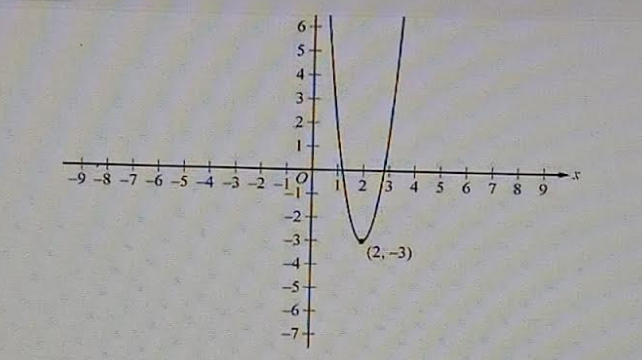
Value of k must be greater than 3.
For the graph of the equation \(y = 5x^2 - 20x + (17 + k)\) to not intersect the x-axis, the discriminant must be negative. The discriminant is calculated as \(b^2 - 4ac\), where \(a = 5\), \(b = -20\), and \(c = 17 + k\). Setting the discriminant to be less than zero leads us to find that \(k\) must be greater than 3.
If \(k = -3\), then the constant term becomes \(17 - 3 = 14\). The discriminant would be calculated as \((-20)^2 - 4(5)(14) = 400 - 280 = 120\), which is positive. This indicates that the graph would intersect the x-axis at two points.
Setting \(k = 2\), the new constant term is \(17 + 2 = 19\). The discriminant then becomes \((-20)^2 - 4(5)(19) = 400 - 380 = 20\), which is also positive. Thus, the graph would still intersect the x-axis at two points.
If \(k = 3\), the constant term becomes \(17 + 3 = 20\). The discriminant would be \((-20)^2 - 4(5)(20) = 400 - 400 = 0\). A zero discriminant indicates that the graph touches the x-axis at one point (a double root), meaning it does not satisfy the condition of not intersecting the x-axis.
Choosing \(k = 4\), the constant term is \(17 + 4 = 21\). The discriminant then calculates to \((-20)^2 - 4(5)(21) = 400 - 420 = -20\), which is negative. This confirms that the graph does not intersect the x-axis.
For the graph of \(y = 5x^2 - 20x + (17 + k)\) to not intersect the x-axis, the discriminant must be negative. The calculations show that \(k\) must be greater than 3, making \(k = 4\) the only valid choice. Thus, values of \(k\) less than or equal to 3 still allow for intersections with the x-axis, while \(k = 4\) ensures the graph remains entirely above it.
Related Questions
View allIf (x+2)/3=(2x-1)/4 then x=
Of the following expressions, which is equivalent to 2^xâ‹…4^2x?
√171 - √19 =
When the Sun is 35 degrees above the horizon, the length of a tree's s...
The population of a certain bacteria can be modeled by the function P(...
Related Quizzes
View allACCUPLACER Next Generation Arithmetic
Next Generation ACCUPLACER Arithmetic Practice Test
ACCUPLACER Next Generation Arithmetic Answers
Next Generation Arithmetic ACCUPLACER
Next-Generation ACCUPLACER Arithmetic
ACCUPLACER Next-Generation Arithmetic Scores
ACCUPLACER Next Generation Quantitative Reasoning Algebra and Statistics
ACCUPLACER Next Generation Quantitative Reasoning Algebra and Statistics Answers
Next Generation ACCUPLACER Score Quantitative Reasoning Algebra and Statistics
ACCUPLACER Next Generation Quantitative Reasoning Algebra and Statistics Scores
- ✓ 500+ Practice Questions
- ✓ Detailed Explanations
- ✓ Progress Analytics
- ✓ Exam Simulations