
When the Sun is 35 degrees above the horizon, the length of a tree's shadow is 46 feet, as shown. How tall is the tree to the nearest foot?
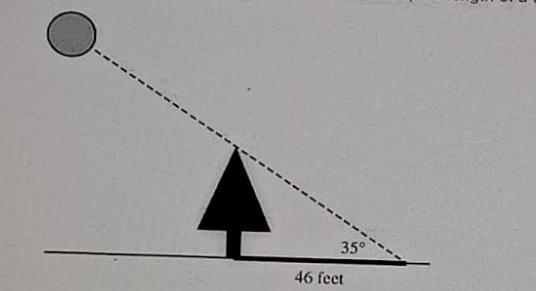
The tree is 32 feet tall.
Using the relationship between the angle of elevation and the length of the shadow, we can apply basic trigonometry. The tangent of the angle formed by the Sun (35 degrees) is equal to the height of the tree divided by the length of the shadow. Thus, height = shadow × tan(35 degrees), which calculates approximately to 32 feet when rounded to the nearest foot.
This choice correctly reflects the height of the tree based on the calculations derived from the tangent function. By applying the formula height = shadow × tan(35 degrees) with a shadow length of 46 feet, we find the height to be approximately 32 feet, confirming this option.
This choice is incorrect as it overestimates the height. If we used this value, it would imply a tangent of the angle that does not correspond to the 35 degrees given, indicating a misunderstanding of the relationship between shadow length and tree height.
This option also misrepresents the tree's height. A height of 66 feet suggests a much steeper angle than 35 degrees. Using the tangent function, this would require a significantly longer shadow than 46 feet, making it mathematically improbable.
This choice is the most inaccurate. An 80-foot tall tree would indicate a tangent that is far beyond what is possible with a 35-degree angle. This height would not correspond to the shadow length provided, thus rendering it impossible.
The height of the tree is determined through trigonometric principles, specifically using the tangent of the angle formed by the Sun's position. Given the parameters of a 35-degree angle and a shadow length of 46 feet, the calculated height of 32 feet aligns with the mathematical model, making option A the correct answer. All other choices fail to adhere to the geometric relationships outlined, leading to incorrect estimates of the tree's height.
Related Questions
View allOf the following expressions, which is equivalent to 2^xâ‹…4^2x?
The ages, in years, of the six members of a chess club are listed abov...
The table above shows some values for the function f. If f(x)=ka^x for...
The graph of y = log_10(x) in the xy-plane intersects the y-axis at wh...
A hose can fill a cubical tank of edge length 1 meter in 15 minutes. A...
Related Quizzes
View allACCUPLACER Next Generation Arithmetic
Next Generation ACCUPLACER Arithmetic Practice Test
ACCUPLACER Next Generation Arithmetic Answers
Next Generation Arithmetic ACCUPLACER
Next-Generation ACCUPLACER Arithmetic
ACCUPLACER Next-Generation Arithmetic Scores
ACCUPLACER Next Generation Quantitative Reasoning Algebra and Statistics
ACCUPLACER Next Generation Quantitative Reasoning Algebra and Statistics Answers
Next Generation ACCUPLACER Score Quantitative Reasoning Algebra and Statistics
ACCUPLACER Next Generation Quantitative Reasoning Algebra and Statistics Scores
- ✓ 500+ Practice Questions
- ✓ Detailed Explanations
- ✓ Progress Analytics
- ✓ Exam Simulations