
A recipe for pancakes serves 4 people and requires 1.5 cups of flour. If the cook wants to make enough pancakes to serve 8 people, how much flour is needed?
Rationale
A) 3 cups of flour is required to make enough pancakes to serve 8 people.
This question involves simple proportional reasoning. If serving 4 people requires 1.5 cups of flour, then serving twice as many people (8 people) would require twice as much flour, which equals 3 cups.
A) 3 cups
This is the correct answer. As explained above, if 1.5 cups of flour serves 4 people, then to serve 8 people (twice as many), you would need twice as much flour, which equals 3 cups.
B) 5.5 cups
This answer would imply more than a proportional increase in the amount of flour needed. However, the question implies a direct proportion between the number of servings and the amount of flour required: if the number of servings doubles, the amount of flour should also double.
C) 8 cups
This answer would imply that each person requires 1 cup of flour, which is not consistent with the information provided in the question. According to the original recipe, serving 4 people requires 1.5 cups of flour, not 4 cups.
D) 1.5 cups
This is the amount of flour required to serve 4 people, according to the original recipe. If the number of servings is doubled to 8 people, the amount of flour required would also need to be doubled.
Conclusion
The recipe's requirement of 1.5 cups of flour to serve 4 people sets up a simple proportion. To serve 8 people, which is twice as many, the cook would need twice the amount of flour, or 3 cups. Therefore, the correct answer is A) 3 cups. Other choices suggest non-proportional increases or inconsistencies with the information provided in the question.
A nurse has just transferred to a new hospital and is still getting used to working in pounds instead of kilograms. Given that 1 kilogram (kg) = 2.2 pounds (lb), what does a 176 lb patient weigh in kg?
Rationale
The patient weighs 80 kg.
To convert pounds to kilograms, the weight in pounds is divided by the conversion factor of 2.2. Therefore, a weight of 176 pounds would be approximately 80 kilograms when converted.
A) 178.2 kg
This is incorrect because to convert pounds to kilograms, the weight in pounds should be divided by 2.2, not multiplied. Multiplying would result in a weight that is larger than the original, which is not correct in this case.
B) 387.2 kg
This is incorrect because it suggests that the conversion factor used was significantly higher than 2.2. Using the correct conversion factor of 2.2, the weight in kilograms should be much less than 387.2 kg.
C) 80 kg
This is the correct answer. To convert 176 pounds to kilograms, the weight in pounds is divided by the conversion factor of 2.2, which gives a result of approximately 80 kilograms.
D) 38.72 kg
This is incorrect because it indicates that the conversion factor used was less than 2.2. Using the correct conversion factor of 2.2, the weight in kilograms should be higher than 38.72 kg.
Conclusion
The correct conversion from pounds to kilograms involves dividing the weight in pounds by the conversion factor of 2.2. In this case, a patient weighing 176 pounds would weigh approximately 80 kilograms. The other options represent incorrect conversions, either by using a conversion factor that was too high, too low, or by applying the conversion factor in the wrong direction (multiplying instead of dividing).
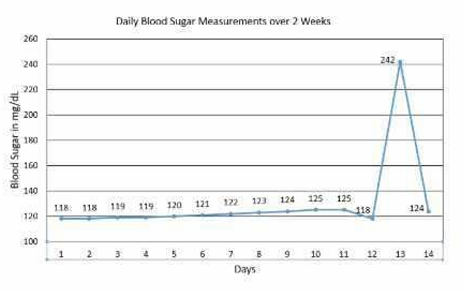
Which measure of central tendency would be the best representation of blood sugar measurements based on the graph below?
Rationale
Median is the best representation of blood sugar measurements based on the graph.
Median is the middle value in a data set when the values are arranged in order of magnitude. It is less sensitive to extreme values (outliers) and can therefore provide a more accurate representation of central tendency, especially when the data is skewed.
A) Mode
Mode is the most frequently occurring value in a data set. While it can provide useful information about the most common blood sugar level, it may not represent the central tendency of the entire data set, particularly if the data is not uniformly distributed or has outliers.
B) Median
The median is the value separating the higher half from the lower half of a data set. This makes it a reliable measure of central tendency, even in the presence of outliers or skewed data, as it always represents the middle value. In the context of blood sugar measurements where outliers could potentially skew the data, the median provides a more reliable central measure.
C) Range
Range represents the difference between the highest and lowest values in a data set. While it provides information about the spread of values, it doesn't give any insight into the central tendency of the data. Therefore, range would not be the best representation of blood sugar measurements in this context.
D) Mean
Mean is the average value of a data set. However, it can be significantly affected by extreme values or outliers. In a data set with skewed distribution, like blood sugar levels might have, the mean might not accurately represent the central tendency of the data.
Conclusion
In the context of blood sugar measurements, the median is the most reliable measure of central tendency. It accurately represents the middle value of the data set, regardless of the presence of outliers or skewed distribution. Other measures like mode, range, and mean, while informative, may be influenced by the distribution and spread of the data and thus may not accurately represent the central tendency in this context.
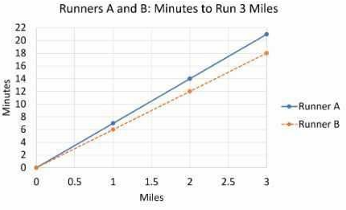
The graph below displays the time in which it takes Runner A and Runner B to run 3 miles. Which statement correctly interprets the slope of the data displayed?
Rationale
Runner B is a faster runner because the slope of the data is 6.
In the context of the graph, the slope represents the speed at which each runner completes 3 miles. The lower the slope, the faster the runner, as they take less time to run the same distance. Therefore, a slope of 6 for Runner B indicates that they are faster than Runner A.
A) Runner A is a faster runner because the slope of the data is 6.
This statement is incorrect because the slope of 6 corresponds to Runner B, not Runner A. Additionally, the lower slope indicates a faster speed, so even if the slope of 6 did correspond to Runner A, this would make Runner A the faster runner, not the slower.
B) Runner A is a faster runner because the slope of the data is 7.
This statement is also incorrect. Even if the slope for Runner A were 7, this would mean that Runner A is slower than Runner B, whose slope is 6. A higher slope indicates a slower speed, as it takes more time to run the same distance.
D) Runner B is a faster runner because the slope of the data is 7.
This statement is incorrect because the slope for Runner B is actually 6, not 7. Moreover, if Runner B's slope were 7, this would make him slower, not faster, as a higher slope indicates a longer time to run the same distance.
Conclusion
The slope of a graph in this context represents speed. The lower the slope, the faster the runner. Therefore, with a slope of 6, Runner B is the faster runner. Misinterpretations of the graph's slope as it pertains to each runner's speed led to the incorrect conclusions in options A, B, and D.
Given that military time uses a 24-hour clock (12:00 midnight equals to 24:00), what time is 1/3 of a day past 9:15 a.m. in military time?
Rationale
17:15 hours is 1/3 of a day past 9:15 a.m. in military time.
In military time, a full day is 24 hours. Therefore, 1/3 of a day equals 8 hours. Adding 8 hours to 9:15 a.m. gives us 17:15 hours in military time.
A) 17:15 hours
This is the correct answer. Adding 8 hours (which is 1/3 of a 24-hour day) to 9:15 a.m. gives us 17:15 hours.
B) 12:15 hours
This answer is incorrect as it represents only 3 hours past 9:15 a.m., which is not 1/3 of a day.
C) 21:15 hours
This answer is incorrect as it represents 12 hours past 9:15 a.m., which is half a day, not 1/3 of a day.
D) 15:15 hours
This answer is incorrect as it represents 6 hours past 9:15 a.m., which is 1/4 of a day, not 1/3 of a day.
Conclusion
Given that military time uses a 24-hour clock and 1/3 of a day is 8 hours, 1/3 of a day past 9:15 a.m. is 17:15 hours. Other times represent different fractions of the day past 9:15 a.m., and are therefore incorrect.
Free Preview Ended
You've seen the first 5 questions.
Subscribe to unlock the remaining 13 questions + full features.
0/0 correct
18 left
You are leaving this quiz
What would you like to do with your progress?
You're in the middle of a quiz
What would you like to do before switching?
Report an Issue
Help us improve by flagging this content.
Rate this Practice Test
How helpful was this material?