
The government justified the action depicted in the image as a
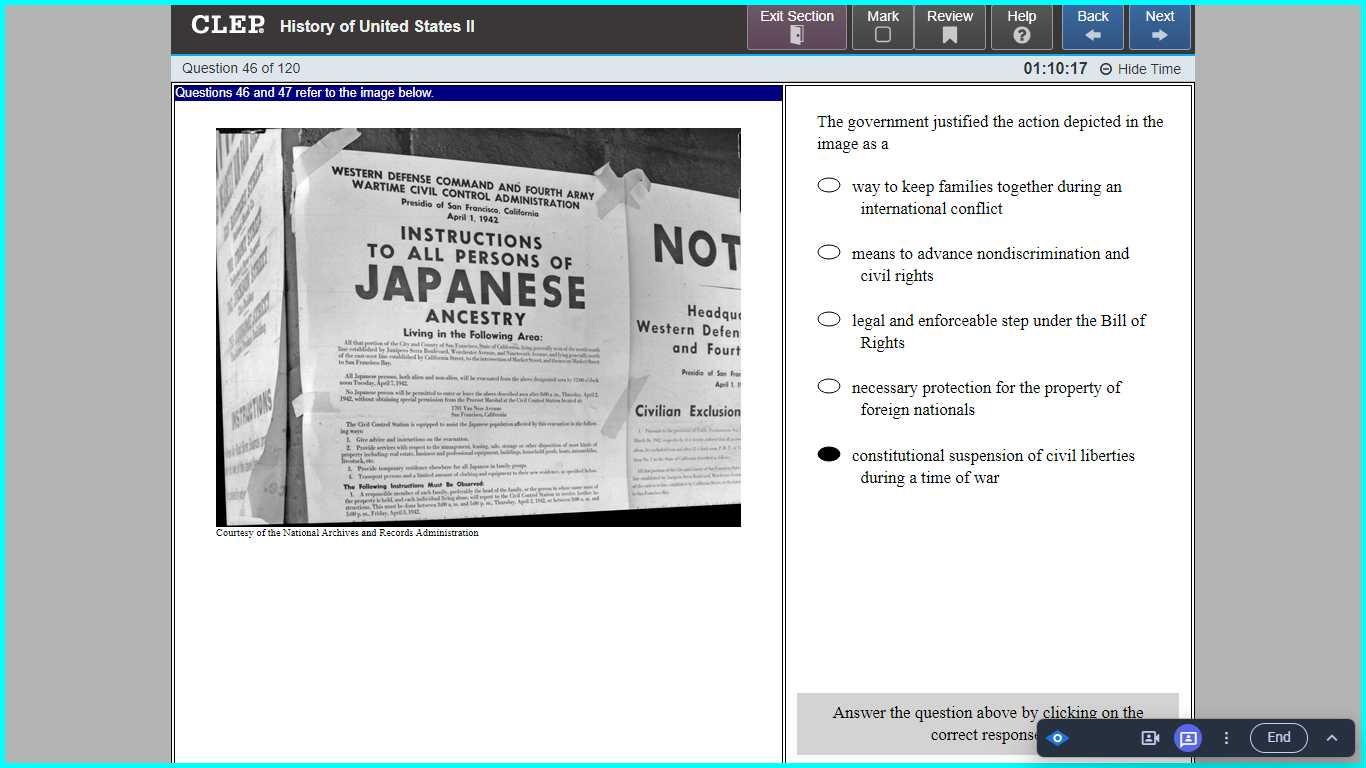
Constitutional suspension of civil liberties during a time of war.
The government's action depicted in the image was justified as a necessary measure to address security concerns during wartime, leading to the suspension of certain civil liberties. This justification often arises in the context of perceived threats to national security, where actions deemed extreme are rationalized under the pretext of protecting the state.
This choice suggests a humanitarian rationale, which does not align with the government's justification for actions taken during wartime. The focus on maintaining family unity does not reflect the typical legal justifications provided for suspending civil liberties, which are often more related to national security than familial considerations.
While advancing civil rights is a noble cause, it contradicts the premise of suspending civil liberties. Government actions justified under wartime conditions typically involve restrictions rather than advancements in civil rights, particularly when such actions disproportionately affect specific groups.
This choice misrepresents the nature of the actions taken. While the Bill of Rights protects civil liberties, wartime measures often involve their suspension rather than legal enforcement. Hence, this justification does not accurately reflect the context of the depicted action.
This choice implies a focus on foreign interests, which is not the core justification for the suspension of civil liberties during wartime. The government’s rationale typically centers more on internal security concerns rather than the protection of foreign nationals' property.
The government's justification for the action depicted in the image revolves around the constitutional suspension of civil liberties during wartime, often framed as essential for national security. While each incorrect choice presents a different angle, they fail to capture the reality of how civil liberties are typically treated in a conflict context, emphasizing the legal and societal complexities that arise when security concerns override individual rights.
Related Questions
View allWhich of the following was the most popular form of the new mass cultu...
Which Supreme Court ruling first established that Americans had a righ...
Which of the following began his career as a leader of the American Ra...
President Franklin D. Roosevelt's fireside chats increased public supp...
Booker T. Washington founded
Related Quizzes
View allAmerican Government CLEP Cheat Sheet
CLEP College Algebra Exam Questions
CLEP College Algebra Exam Guide
CLEP College Mathematics Exam Secrets Study Guide
CLEP History of the United States II Examination Guide
Humanities CLEP Test Study Guide
CLEP Humanities Test Questions
CLEP Introductory Psychology Examination Guide
College Level Examination Program CLEP Exams Hack
CLEP Western Civilization I Exam Secrets Study Guide
- ✓ 500+ Practice Questions
- ✓ Detailed Explanations
- ✓ Progress Analytics
- ✓ Exam Simulations