
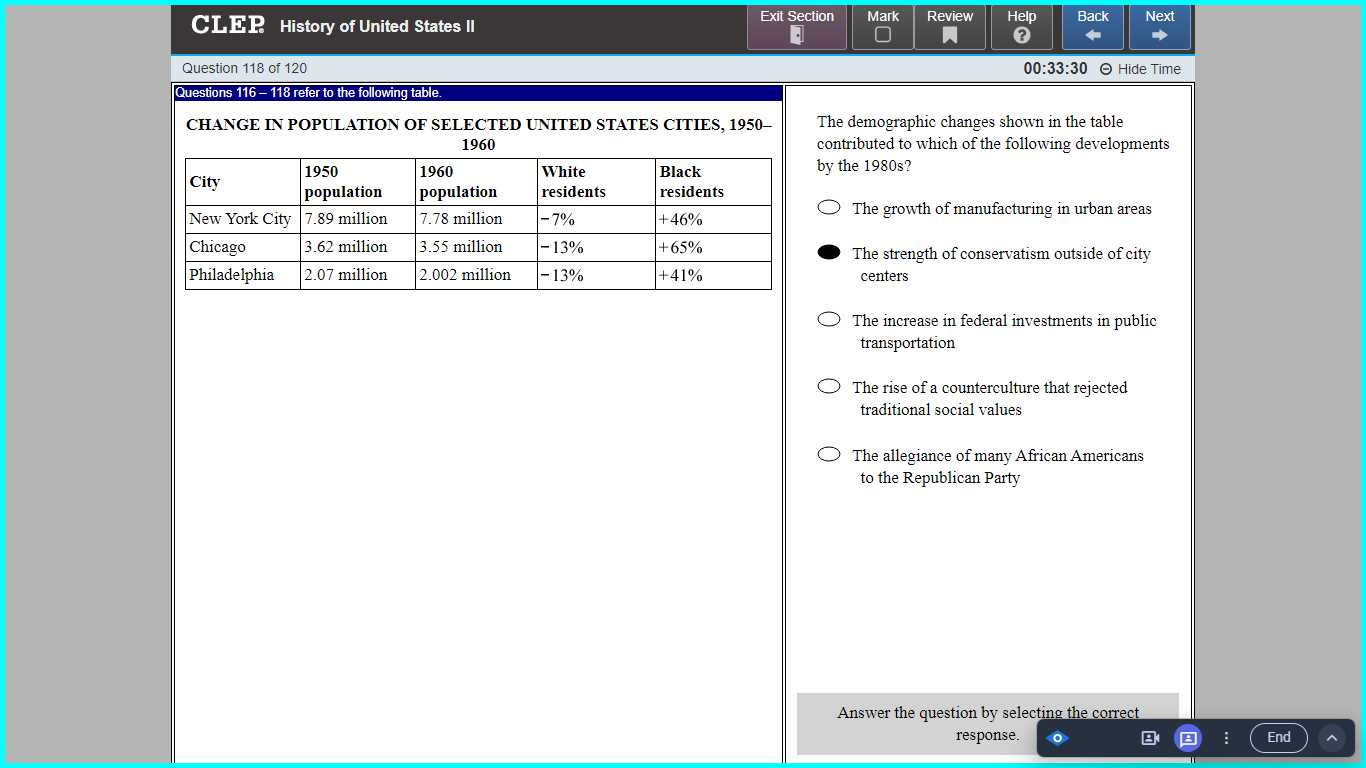
The demographic changes shown in the table contributed to which of the following developments by the 1980s?
The strength of conservatism outside of city centers.
The demographic changes indicated a significant migration of populations from urban areas to suburban and rural regions, which often correlated with the rise of conservative political values in these communities during the 1980s.
Manufacturing in urban areas experienced challenges during the late 20th century, including deindustrialization and the movement of jobs overseas. The demographic shifts toward suburban living did not contribute to the growth of manufacturing but rather indicated a decline in urban industrial employment.
As populations moved from cities to suburban and rural areas, these regions tended to adopt more conservative political ideologies. The demographic changes facilitated a stronger conservative base, as suburban voters often prioritized different social and economic issues compared to their urban counterparts.
Federal investments in public transportation were often targeted at urban areas, where public transit needs were more pronounced. The shift toward suburban living typically reduced the demand for public transportation investment, as suburbs are generally designed around personal vehicle use rather than mass transit systems.
The counterculture movement was more prominent in urban areas during the 1960s and 1970s and was characterized by its rejection of traditional values. By the 1980s, the demographic shifts toward suburbs did not foster a counterculture; instead, they aligned more with conservative values and traditional social norms.
While some demographic shifts influenced political affiliations, the primary allegiance of African Americans historically leaned toward the Democratic Party, particularly during the 1980s, due to a range of social and economic issues that resonated more with Democratic policies than Republican ones.
The demographic changes reflected a significant movement towards suburbanization, which in turn fostered a stronger conservative political presence outside city centers by the 1980s. This shift highlighted the divergence in political ideologies between urban and suburban populations, with the latter increasingly embracing conservative values during this period.
Related Questions
View allA landmark law that transformed the face of American higher education...
The Spanish-American War hastened the construction of the Panama Canal...
Which of the following was the most popular form of the new mass cultu...
Which of the following best describes the attitude of most Americans a...
Which of the following policies was generally supported by Radical Rep...
Related Quizzes
View allAmerican Government CLEP Cheat Sheet
CLEP College Algebra Exam Questions
CLEP College Algebra Exam Guide
CLEP College Mathematics Exam Secrets Study Guide
CLEP History of the United States II Examination Guide
Humanities CLEP Test Study Guide
CLEP Humanities Test Questions
CLEP Introductory Psychology Examination Guide
College Level Examination Program CLEP Exams Hack
CLEP Western Civilization I Exam Secrets Study Guide
- ✓ 500+ Practice Questions
- ✓ Detailed Explanations
- ✓ Progress Analytics
- ✓ Exam Simulations