
The artist who created the work shown above, an appropriated Neolithic vase (5000-3000 BCE) inscribed with the Coca-Cola logo, was also commissioned as the artistic consultant on the construction of the Beijing National Stadium for the 2008 Olympics. This artist is
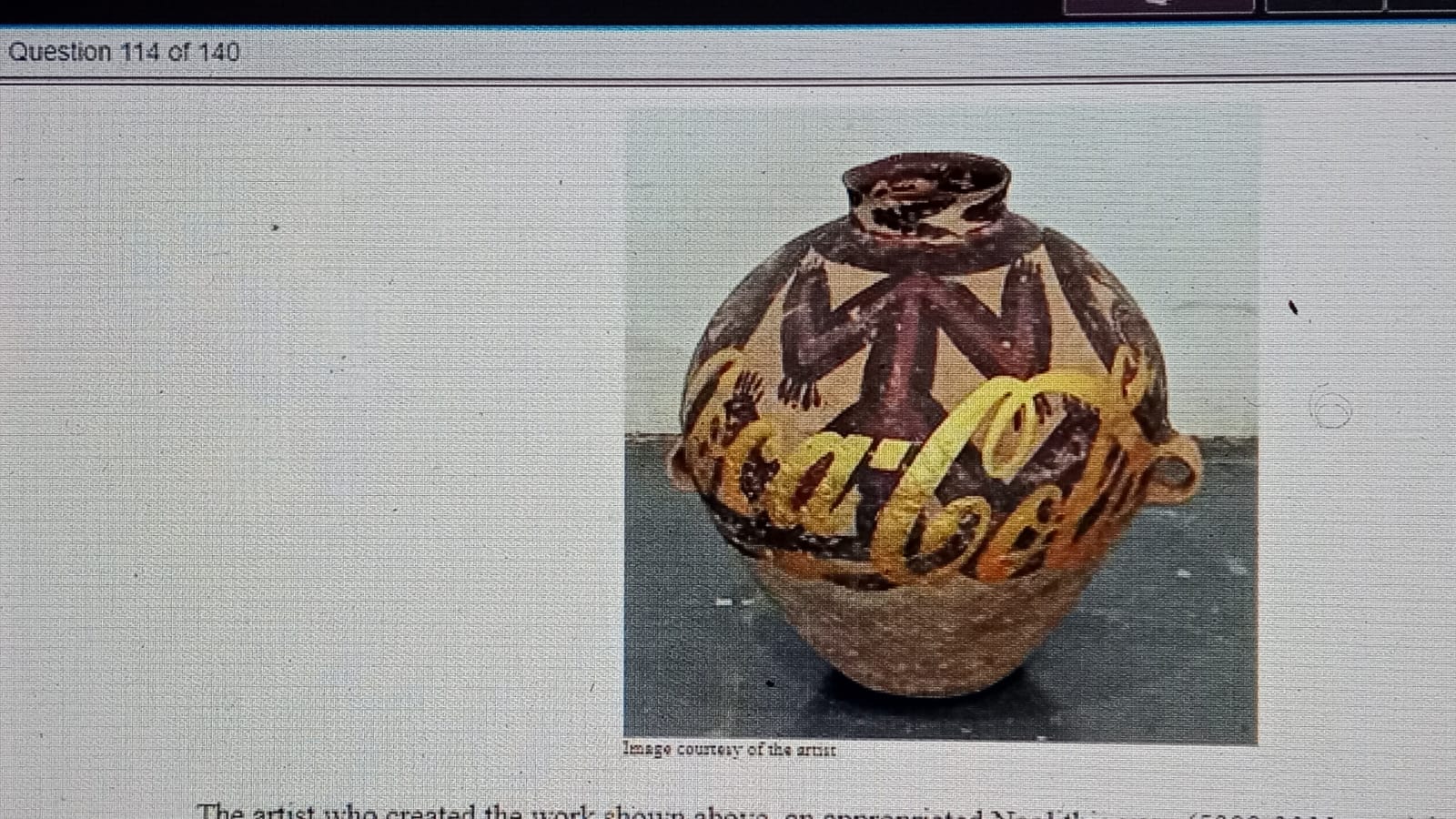
Ai Weiwei is the artist who created the appropriated Neolithic vase inscribed with the Coca-Cola logo and served as the artistic consultant for the Beijing National Stadium.
Ai Weiwei is renowned for his innovative blending of traditional art forms and contemporary themes, exemplified in his appropriation of historical artifacts like the Neolithic vase. His role as an artistic consultant in the construction of the Beijing National Stadium further solidifies his influence in both art and architecture, particularly in the context of major cultural events.
Seung Mo Park is known for his intricate wire sculptures and installations, but he has not been associated with the creation of appropriated Neolithic works or the Beijing National Stadium. His artistic focus differs significantly from Ai Weiwei's, as he typically explores themes related to identity and materiality rather than political commentary or cultural critique.
Cai Guo-Qiang is celebrated for his explosive art installations and use of gunpowder in creating ephemeral works. While he is a prominent contemporary artist, he did not create the vase in question nor served as the consultant for the Beijing National Stadium. His artistic trajectory emphasizes large-scale installations and performance rather than the appropriation of historical artifacts.
Maya Lin is famous for her minimalist and environmental art, particularly the Vietnam Veterans Memorial. Although she is an influential artist, she is not linked to the creation of the Neolithic vase or the Beijing National Stadium. Her work typically focuses on the relationship between nature and memory rather than the appropriation of cultural symbols.
Chiharu Shiota is known for her installation art that often incorporates thread and found objects to explore themes of memory and the human experience. While she is an innovative artist, she has no connection to the Neolithic vase or the Beijing National Stadium. Her work is distinctively different in style and thematic focus compared to Ai Weiwei's.
Ai Weiwei's unique approach to art, which combines historical references with contemporary culture, is exemplified in his appropriated Neolithic vase. His significant role in the construction of the Beijing National Stadium further highlights his influence in the realm of public art and architecture. The other artists listed, while talented in their own right, do not share the same contributions to the specific work or project referenced in the question.
Related Questions
View allAn Irish poet and dramatist, he was a founder of the Abbey Theatre and...
An epic Sanskrit work of ancient India, it contains not only descripti...
Many scholars consider this eleventh-century work by Lady Murasaki Shi...
The poem was written by
The Remains of the Day, a novel by Kazuo Ishiguro, takes place in whic...
Related Quizzes
View allAmerican Government CLEP Cheat Sheet
CLEP College Algebra Exam Questions
CLEP College Algebra Exam Guide
CLEP College Mathematics Exam Secrets Study Guide
CLEP History of the United States II Examination Guide
CLEP History of the United States II Examination Guide
Humanities CLEP Test Study Guide
CLEP Introductory Psychology Examination Guide
College Level Examination Program CLEP Exams Hack
CLEP Western Civilization I Exam Secrets Study Guide
- ✓ 500+ Practice Questions
- ✓ Detailed Explanations
- ✓ Progress Analytics
- ✓ Exam Simulations