
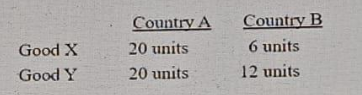
Country A: 20X & 20Y; Country B: 6X & 12Y. Which is true?
Country A has a comparative advantage in X.
Country A produces 20 units of X and 20 units of Y, while Country B produces 6 units of X and 12 units of Y. To determine comparative advantage, we compare the opportunity costs of producing each good in both countries. Country A has a lower opportunity cost for X compared to Country B, indicating it can produce X more efficiently relative to Y.
Country A's ability to produce 20 units of X with an opportunity cost of giving up only 1 unit of Y supports its comparative advantage in X. In contrast, Country B's opportunity cost for producing X is higher, thus making A the more efficient producer of X.
This statement is incorrect because while Country A produces an equal amount of Y, its opportunity cost for Y is higher compared to Country B, which sacrifices fewer units of X to produce Y. Therefore, A does not have a comparative advantage in Y.
Although Country B produces less of X, absolute advantage refers to the ability to produce more of a good than another country. Here, Country A produces more units of X (20 vs. 6), meaning Country B does not have an absolute advantage in X.
Country B cannot have a comparative advantage in both goods because it is less efficient in producing X compared to Country A. For B to hold a comparative advantage, it would need to have a lower opportunity cost than A in one or both goods, which is not the case here.
Comparative advantage is determined by opportunity costs, and in this scenario, Country A's production of X is more efficient than that of Country B. As a result, Country A holds a comparative advantage in X, while Country B is at a disadvantage in both goods due to higher opportunity costs associated with their production. This insight is crucial for understanding trade dynamics between countries.
Related Questions
View allShort-run Phillips curve shows:
Which unemployment type results from technological change?
Real interest rate equals nominal minus expected inflation is:
Company replaces workers with robots—this illustrates investment in:
Quantity of money demanded varies:
Related Quizzes
View allAmerican Government CLEP Cheat Sheet
CLEP College Algebra Exam Questions
CLEP College Algebra Exam Guide
CLEP College Mathematics Exam Secrets Study Guide
CLEP History of the United States II Examination Guide
CLEP History of the United States II Examination Guide
Humanities CLEP Test Study Guide
CLEP Humanities Test Questions
CLEP Introductory Psychology Examination Guide
CLEP Western Civilization I Exam Secrets Study Guide
- ✓ 500+ Practice Questions
- ✓ Detailed Explanations
- ✓ Progress Analytics
- ✓ Exam Simulations