
A medical researcher has been reviewing the data between amount of time spent on a treadmill and high blood pressure. What is the correlation between the two variables?
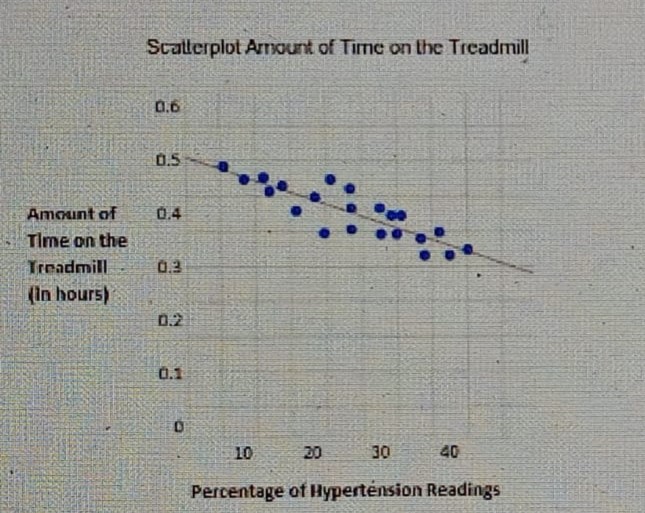
There is a negative correlation between the amount of time spent on a treadmill and high blood pressure.
Research typically indicates that increased time spent exercising on a treadmill is associated with lower blood pressure levels, suggesting that as one variable increases, the other decreases. This inverse relationship characterizes a negative correlation.
A positive correlation implies that as one variable increases, so does the other. In this context, if there were a positive correlation, it would mean that more time on the treadmill leads to higher blood pressure, which contradicts established findings in exercise physiology that suggest the opposite effect.
A negative correlation signifies an inverse relationship between two variables, where an increase in one results in a decrease in the other. In this case, more time spent on the treadmill generally leads to a reduction in high blood pressure, aligning with the findings of numerous studies that promote exercise as a means to manage hypertension.
A weak correlation would imply that there is a minimal or unclear relationship between the two variables. However, the relationship between treadmill time and high blood pressure is typically well-documented, showing a clear negative correlation rather than a weak one, thus invalidating this option.
A zero correlation indicates no relationship between the two variables. This option is incorrect as there is substantial evidence demonstrating that increased exercise time is associated with lower blood pressure levels, thereby indicating a definite relationship rather than a lack thereof.
The relationship between time spent on a treadmill and high blood pressure is characterized by a negative correlation, where increased physical activity correlates with lower blood pressure levels. This understanding is crucial for medical researchers and practitioners aiming to promote exercise as an effective strategy for hypertension management. All other correlation types discussed fail to accurately describe the established dynamics between these two variables.
Related Questions
View allA study is conducted to determine the relationship between blood press...
What is the answer to the following expression when using the correct...
How will the removal of the outliers affect the relationship between s...
A study is conducted to determine the most common blood pressure readi...
A normally distributed data set of lab values has a mean of 278 and a...
Related Quizzes
View all0PC1 Planning Instructional Strategies for Meaningful Learning Version 1
AP01 Elementary Literacy Curriculum Version 1
ASO1 Introduction to Statistics for Research Version 1
BJ01 Introduction to Business Finance Version 1
C172 Network and Security Foundations Version 1
C180 Introduction to Psychology Version 1
C180 Introduction to Psychology Version 2
CKC1 Introduction to Humanities Version 1
DZ01 Mathematics for Elementary Educators III MATH 1330 Version 1
FF01 Human Growth and Development Version 1
- ✓ 500+ Practice Questions
- ✓ Detailed Explanations
- ✓ Progress Analytics
- ✓ Exam Simulations