
Which muscle shown below functions to hold the internal organs in place?
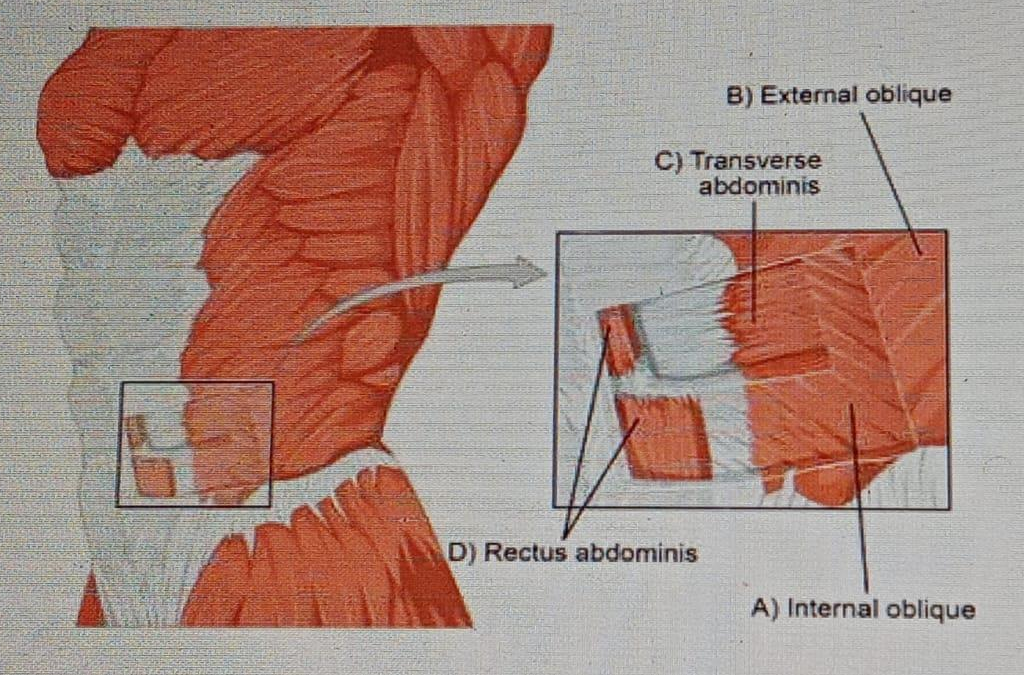
Transverse abdominis functions to hold the internal organs in place.
The transverse abdominis is a deep abdominal muscle that plays a critical role in stabilizing the core and supporting the internal organs. Its horizontal fiber orientation enables it to create tension in the abdominal wall, thereby effectively holding organs in position during movement and activity.
The internal oblique muscle is positioned beneath the external oblique and assists in trunk rotation and lateral flexion. While it contributes to core stability, its primary function is not to hold the internal organs in place, but rather to facilitate movement and support during dynamic activities.
The external oblique is the largest and most superficial of the abdominal muscles, involved in trunk rotation and flexion. Like the internal oblique, it aids in movement and stability, but it does not specifically function to anchor internal organs, making it less relevant to the question.
This muscle is specifically designed to stabilize the pelvis and lumbar spine while holding the internal organs in place. Its unique horizontal alignment allows it to compress the abdomen effectively, providing necessary support and stability to the internal structures during various activities.
The rectus abdominis is primarily responsible for flexing the lumbar spine and is known for its role in creating the "six-pack" appearance. While it contributes to overall core strength, it does not directly function to secure the internal organs in place, distinguishing it from the transverse abdominis.
The transverse abdominis is essential for maintaining the position of internal organs, providing core stability, and facilitating proper posture. Unlike the other abdominal muscles, which are more involved in movement and trunk flexion, the transverse abdominis uniquely serves to anchor and support the internal structures within the abdominal cavity. This specialization highlights its importance in overall bodily function and stability.
Related Questions
View allWhich hormones of the anterior pituitary are collectively referred to...
Which part of the hair contains cells that are actively reproducing?
Which muscle holds the patella in place?
Which label in the following image shows the only bone that is movable...
Where on the body would a hinge joint be found?
Related Quizzes
View all0PC1 Planning Instructional Strategies for Meaningful Learning Version 1
AP01 Elementary Literacy Curriculum Version 1
AQ01 Applied Healthcare Statistics C784 Version 1
ASO1 Introduction to Statistics for Research Version 1
BJ01 Introduction to Business Finance Version 1
C172 Network and Security Foundations Version 1
C180 Introduction to Psychology Version 1
C180 Introduction to Psychology Version 2
CKC1 Introduction to Humanities Version 1
DZ01 Mathematics for Elementary Educators III MATH 1330 Version 1
- ✓ 500+ Practice Questions
- ✓ Detailed Explanations
- ✓ Progress Analytics
- ✓ Exam Simulations