
What is the four-firm concentration ratio for the companies?
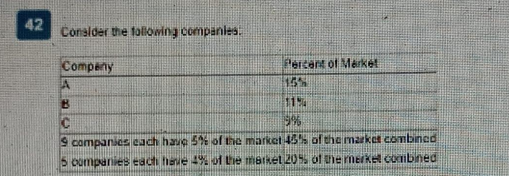
The four-firm concentration ratio for the companies is 40.
The four-firm concentration ratio (CR4) measures the total market share held by the four largest firms in an industry. In this case, a concentration ratio of 40 indicates that these top firms collectively hold 40% of the market share.
A concentration ratio of 60 would imply that the four largest firms control 60% of the market, which is inaccurate based on the provided data. This figure suggests a higher level of concentration than what is reported, indicating a misunderstanding of the firms' market share distribution.
This is the correct answer, reflecting that the four largest companies in the market hold 40% of the total market share. This ratio effectively captures the competitive landscape and indicates a moderate level of concentration within the industry.
A concentration ratio of 452 is not feasible since concentration ratios are expressed as percentages ranging from 0 to 100. This excessively high number suggests a fundamental error in calculation or interpretation, as it exceeds the total market potential.
Similar to option C, a concentration ratio of 732 is impossible as it surpasses the maximum percentage of 100. This option reflects a critical misunderstanding of how concentration ratios function, as they cannot represent values beyond the total market share.
The four-firm concentration ratio is a crucial indicator of market structure, showing the extent to which a few firms dominate the industry. In this case, a CR4 of 40 highlights a moderate concentration level, suggesting a competitive environment among the largest firms. Understanding these ratios is vital for analyzing market dynamics and assessing competition.
Related Questions
View allCoffee is a normal good. If the average income of consumers increases,...
Which term describes the acquisition of skills resulting from educatio...
The Federal Reserve Bank wants to decrease interest rates. Which actio...
Why are production possibility curves usually bowed out from the origi...
What does the demand for a good refer to in economics?
Related Quizzes
View all0PC1 Planning Instructional Strategies for Meaningful Learning Version 1
AP01 Elementary Literacy Curriculum Version 1
AQ01 Applied Healthcare Statistics C784 Version 1
ASO1 Introduction to Statistics for Research Version 1
BJ01 Introduction to Business Finance Version 1
C172 Network and Security Foundations Version 1
C180 Introduction to Psychology Version 1
C180 Introduction to Psychology Version 2
CKC1 Introduction to Humanities Version 1
DZ01 Mathematics for Elementary Educators III MATH 1330 Version 1
- ✓ 500+ Practice Questions
- ✓ Detailed Explanations
- ✓ Progress Analytics
- ✓ Exam Simulations