
What is formed as a result of magma moving up through the Earth's crust as depicted in the illustration (mid-ocean ridge)?
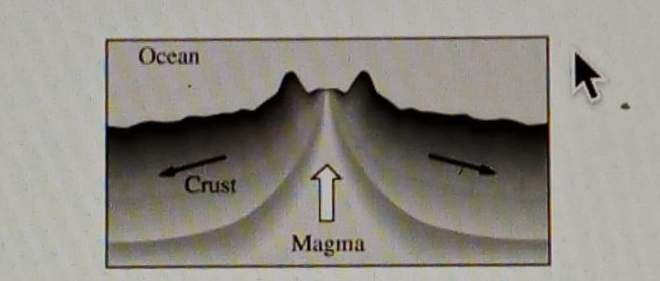
New seafloor is formed as a result of magma moving up through the Earth's crust at mid-ocean ridges.
When magma rises through the Earth's crust at mid-ocean ridges, it solidifies to create new oceanic crust, effectively forming new seafloor. This process is a fundamental aspect of seafloor spreading, contributing to the continual renewal of the ocean floor.
This choice accurately describes the result of magma rising and solidifying at mid-ocean ridges. As magma erupts and cools, it forms basaltic rock, which constitutes the new oceanic crust. This mechanism is essential for understanding plate tectonics and the geological features of the ocean floor.
Coral reefs are complex structures formed by the accumulation of coral polyps, which thrive in shallow, warm waters, typically not at mid-ocean ridges. While coral reefs can form on the ocean floor, they are biologically driven structures distinct from the geological processes related to magma and seafloor formation.
Oceanic trenches are formed at subduction zones where one tectonic plate sinks beneath another. They are not a product of magma rising through the crust but rather the result of tectonic activity where plates converge. Thus, this option does not relate to the process described in the question.
Thrust faults occur due to compressional forces in the Earth's crust, leading to one section of rock being pushed over another. They are associated with convergent plate boundaries and are not a direct result of magma rising at mid-ocean ridges. Therefore, this choice does not pertain to the formation process described.
The movement of magma at mid-ocean ridges leads to the formation of new seafloor, a crucial aspect of the Earth’s geological processes. In contrast, coral reefs, trenches, and thrust faults arise from different geological mechanisms and do not relate to the extrusion of magma. Understanding these distinctions is key to grasping the dynamics of plate tectonics and oceanic development.
Related Questions
View allWhich THREE of the following processes depend directly on solar energy...
Which TWO of the following are examples of structural adaptations?
The surface gravity on Mars is less than on Earth. Which property woul...
Of the following, which is a reactant in the process of photosynthesis...
Which of the following is a way the human body responds to cold enviro...
Related Quizzes
View allPraxis 5001 Test with Answers
Praxis 5002 Study Guide
5002 Praxis Practice Test
Reading & Language Arts Praxis 5002
Praxis 5002 Reading and Language Arts Exam
Praxis 5003 Exam with Outline
5003 Praxis Math Answers
Praxis 5003 Study Guide
Praxis Social Studies 5004
Praxis 5004 Social Studies
- ✓ 500+ Practice Questions
- ✓ Detailed Explanations
- ✓ Progress Analytics
- ✓ Exam Simulations