
A neonatal unit wants to know which of two oxygen delivery systems is associated with a higher incidence of bronchopulmonary dysplasia (BPD) in infants discharged from the hospital in the last two years. Given the following data: Infant Diagnoses by Oxygen Delivery Systems N=100
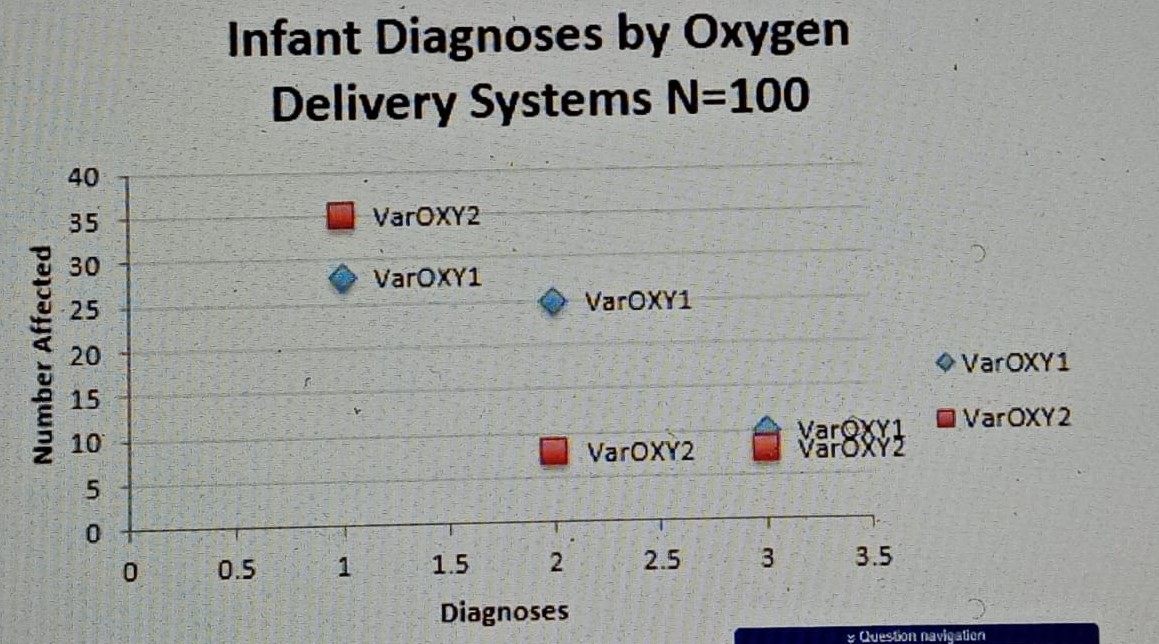
There is an estimated correlation of 1.0 between both systems and BPD.
A correlation of 1.0 indicates a perfect positive relationship between the oxygen delivery systems and the incidence of bronchopulmonary dysplasia (BPD). This suggests that as the use of either oxygen system increases, the incidence of BPD also increases proportionally, which is critical information for the neonatal unit’s evaluation.
This option suggests that oxygen system one has a strong positive correlation with BPD, while oxygen system two has a strong negative correlation. A negative correlation implies that increased use of oxygen system two would lead to a decrease in BPD incidence, which contradicts the premise of evaluating the association of both systems with BPD.
This choice incorrectly refers to oxygen system two twice, which is likely a typographical error. Furthermore, it suggests the same conflicting relationship as option A, indicating a positive correlation alongside a negative correlation for the same system, which is not logically consistent.
A correlation coefficient cannot exceed 1.0, as it ranges from -1.0 to +1.0. Therefore, stating a correlation of 2.0 is mathematically incorrect and invalid. Correlation values greater than 1 are not possible and do not provide any meaningful information regarding the relationship between the systems and BPD.
In summary, the correct interpretation of the data indicates a perfect positive correlation of 1.0 between both oxygen delivery systems and the incidence of bronchopulmonary dysplasia (BPD). This finding is essential for understanding the relationship between oxygen delivery methods and BPD outcomes in infants, as it highlights the potential risks associated with these systems. The other options either contain logical inconsistencies or incorrect values, underscoring the importance of accurate statistical interpretation in clinical settings.
Related Questions
View allWhat is 1/5 x 3/4?
A hospital's latest survey of its service area shows that 30% of the p...
How can this data about body mass index (BMI) and fasting blood sugar...
A study is conducted to determine the most common blood pressure readi...
Which amount should be administered to a patient who needs 1/4 of a on...
Related Quizzes
View all0PC1 Planning Instructional Strategies for Meaningful Learning Version 1
AP01 Elementary Literacy Curriculum Version 1
ASO1 Introduction to Statistics for Research Version 1
BJ01 Introduction to Business Finance Version 1
C172 Network and Security Foundations Version 1
C180 Introduction to Psychology Version 1
C180 Introduction to Psychology Version 2
CKC1 Introduction to Humanities Version 1
DZ01 Mathematics for Elementary Educators III MATH 1330 Version 1
FF01 Human Growth and Development Version 1
- ✓ 500+ Practice Questions
- ✓ Detailed Explanations
- ✓ Progress Analytics
- ✓ Exam Simulations