
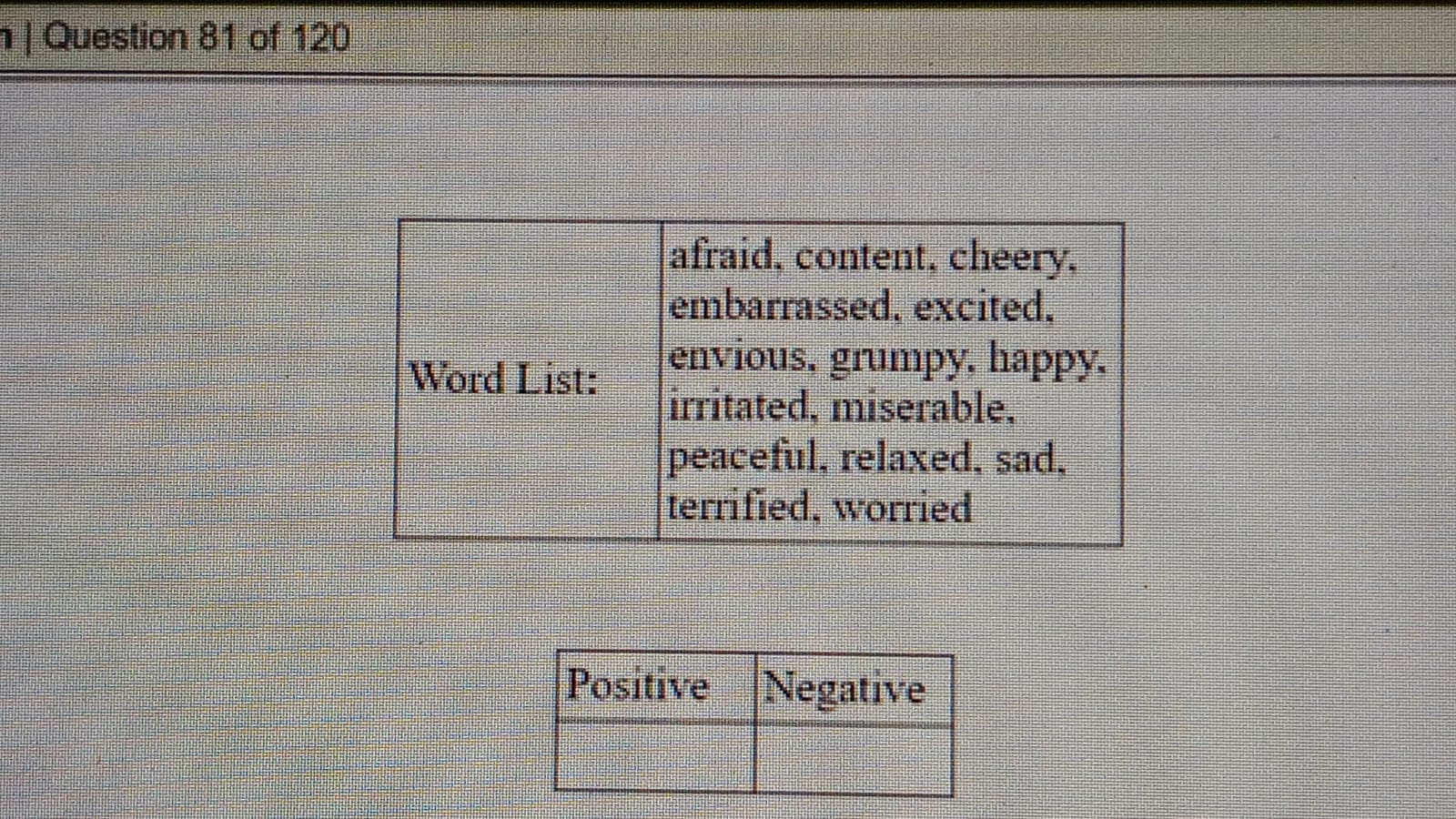
A first-grade teacher designs an interactive lesson to enhance students' emotional understanding. The teacher provides a chart divided into positive and negative sections and a word list containing emotions such as afraid, content, cheery, embarrassed, excited, envious, grumpy, happy, irritated, miserable, peaceful, relaxed, sad, terrified, and worried. Students are asked to match the terms from the list to the appropriate section of the chart. Then, in pairs, one student acts out an emotion while the other guesses it. The lesson's primary focus is to be determined. The lesson will primarily help students to
develop self-awareness
The primary focus of the lesson is to enhance students' emotional understanding, which directly relates to developing self-awareness. By matching emotions to their corresponding categories and acting them out, students learn to identify and understand their own feelings and those of others.
This choice accurately reflects the lesson's intent, as it encourages students to explore their emotions and recognize how they feel in various situations. Understanding and articulating emotions is a foundational skill for self-awareness, allowing students to better manage their feelings and respond to social interactions.
While emotional understanding can aid in problem-solving, this lesson does not explicitly focus on addressing specific problems or conflicts. Instead, it centers on recognizing and expressing emotions, which is a different educational goal that does not directly correlate with problem-solving skills.
Although understanding emotions can help students identify inappropriate behaviors in themselves and others, this lesson primarily aims to enhance emotional understanding rather than directly addressing behavioral issues. The activities do not emphasize behavior correction but rather emotional expression and recognition.
Making friends can be a secondary benefit of improved emotional understanding, but it is not the lesson's primary focus. The activities are designed more around emotional recognition than social skills development, which would include making friends.
The lesson is fundamentally centered on enhancing emotional understanding, leading to the development of self-awareness among students. By engaging in activities that encourage the identification and expression of emotions, students gain vital skills that aid in understanding themselves and their interactions with others. The focus on emotions over problem-solving, behavior recognition, or friendship-making underscores the importance of self-awareness as a foundational element in emotional education.
Related Questions
View allIn a mathematical exercise, students are tasked with matching the appr...
As Darnell reads, he stops between words and points from one word to t...
First-grade students learn that they can represent the same pattern st...
Which of the following physical education activities is the most devel...
Mr. Blackwell plays a game called 'mirrors' with his first-grade stude...
Related Quizzes
View allPraxis 5001 Test with Answers
Praxis 5002 Study Guide
5002 Praxis Practice Test
Reading & Language Arts Praxis 5002
Praxis 5002 Reading and Language Arts Exam
Praxis 5003 Exam with Outline
5003 Praxis Math Answers
Praxis 5003 Study Guide
Praxis Social Studies 5004
Praxis 5004 Social Studies
- ✓ 500+ Practice Questions
- ✓ Detailed Explanations
- ✓ Progress Analytics
- ✓ Exam Simulations