
Fix It Fast is an auto repair shop that employs 10 mechanics. Each day, the shop owner randomly picks 1 mechanic to receive a free lunch. What is the probability the shop owner will pick the same mechanic to receive a free lunch 2 days in a row?
Rationale
The probability the shop owner will pick the same mechanic to receive a free lunch 2 days in a row is 1/100.
Since there are 10 mechanics, the chance of selecting the same mechanic on both days is calculated by multiplying the probability of choosing any one mechanic on the first day (1) by the probability of choosing that same mechanic again on the second day (1/10). This results in a probability of 1/10 for the first selection and 1/10 for the second selection, leading to a combined probability of (1/10) * (1/10) = 1/100.
A) 120
The number 120 does not represent a probability but rather could be mistakenly interpreted as a potential arrangement of mechanics. However, probabilities must be between 0 and 1, and 120 does not fit within this range.
B) 1/100
This choice accurately reflects the probability of selecting the same mechanic two days in a row. With 10 mechanics, the chance of selecting one specific mechanic on the first day is 1, and the chance of selecting the same mechanic again is 1/10, leading to a total probability of 1/100.
C) 15
Similar to choice A, the number 15 does not represent a valid probability. Probabilities must be expressed as fractions or decimals between 0 and 1, and 15 exceeds this range, making it an invalid choice.
D) 110
This option, like A and C, is not a valid probability value. Probabilities cannot exceed 1, and 110 is far outside the acceptable range of probability values, rendering it incorrect.
Conclusion
In summary, the probability of selecting the same mechanic for a free lunch two days in a row at Fix It Fast is correctly represented by 1/100. This is derived from understanding the basic principles of probability, where the likelihood of repeated events is determined by multiplying the probabilities of each individual event. The other options presented do not conform to the definition of probability, reinforcing the importance of calculating probabilities within the appropriate range.
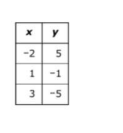
What is the slope of the line represented by the table?
Rationale
The slope of the line represented by the table is -2.
The slope is calculated by taking the change in the y-values divided by the change in the x-values between two points on the line. In this case, the slope of -2 indicates that for every unit increase in the x-direction, the y-value decreases by 2 units.
A) -4
A slope of -4 suggests that for every increase of 1 in the x-direction, the y-value would decrease by 4. However, this does not match the rate of change observed in the table, where a decrease of 2 in y corresponds to an increase of 1 in x.
B) -2.5
A slope of -2.5 would imply that for each unit increase in x, the y-value decreases by 2.5 units. This value is also inconsistent with the observed changes in y relative to x from the table, indicating that the slope is more accurately defined as -2.
D) -0.5
A slope of -0.5 indicates a much gentler decline, meaning that for every unit increase in x, the y-value would only decrease by 0.5. This is clearly not representative of the steep decline reflected in the table, where the y-values drop more sharply.
Conclusion
The slope of a line is a crucial aspect of its representation, indicating the rate of change between two variables. In this instance, the accurate calculation reveals a slope of -2, confirming that for every increase of 1 in the x-values, the y-values drop by 2. The other choices do not align with the data presented in the table, reaffirming that -2 is the only correct interpretation of the slope in this context.
Which graph shows a line described by 4x - 3y = 12?
Rationale
Graph D shows a line described by 4x - 3y = 12.
The equation 4x - 3y = 12 can be rearranged into slope-intercept form (y = mx + b) to identify the correct graph. By isolating y, we find that y = (4/3)x - 4, indicating a slope of 4/3 and a y-intercept of -4, which matches the characteristics of graph D.
A) M-97A.png
This graph does not accurately represent the equation 4x - 3y = 12. The slope and intercept do not match those derived from the equation; specifically, the line appears to have a different slope and crosses the y-axis at a value inconsistent with -4.
B) M-97B.png
Graph B fails to depict the correct slope and y-intercept. The line in this graph appears to have a negative slope, while the equation has a positive slope of 4/3. Additionally, its y-intercept does not align with the expected value of -4.
C) M-97C.png
Graph C also does not represent the line described by the equation. While it has a positive slope, it does not correspond to the slope of 4/3, and its y-intercept does not match -4, confirming it is not the correct representation of the given equation.
D) M-97D.png
This graph accurately reflects the line described by 4x - 3y = 12. The slope of 4/3 and the y-intercept of -4 are correctly represented, aligning perfectly with the rearranged form of the equation.
Conclusion
To solve for the correct graph representing the equation 4x - 3y = 12, we analyze the slope and y-intercept derived from the equation. Graph D is the only option that accurately reflects the slope of 4/3 and the y-intercept of -4, confirming it as the proper representation of the line defined by the equation. The other graphs fail to match these critical characteristics.
An advertisement poster in the window of a shoe store is in the shape of a rectangle. The length of the poster is 9 less than 4 × the width. Which expression represents the length of the poster when w is the width
Rationale
4w - 9 represents the length of the poster when w is the width.
In this problem, the length of the poster is defined as being 9 less than 4 times the width (w). Therefore, the expression that accurately reflects this relationship is 4w - 9.
A) 4w - 9
This expression correctly represents the length of the poster based on the given relationship. It is derived from the problem statement, where the length is specified as 4 times the width minus 9, thus confirming its accuracy.
B) 9 - 4w
This expression suggests that the length is 9 minus 4 times the width, which incorrectly reverses the relationship stated in the question. Instead of being a positive multiple of the width, it inaccurately implies a decrease based on the width, which does not align with the problem.
C) 4w + 9
This expression indicates that the length is 4 times the width plus 9, which contradicts the original statement of the length being less than the calculated width. This misinterpretation results in an incorrect representation of the relationship.
D) 9w - 4
This expression implies that the length is 9 times the width minus 4, which is entirely unrelated to the stated relationship. It does not represent any part of the problem correctly and introduces a different coefficient and constant.
Conclusion
The length of the poster is defined as 9 less than 4 times the width, making 4w - 9 the correct expression for this relationship. The other choices either misinterpret the problem’s conditions or introduce incorrect values, confirming that A is the only valid expression for the length based on the given width.
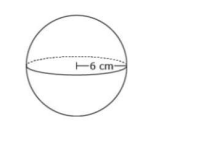
The radius of the sphere below is 6 centimeters (cm). What is the volume, in cubic centimeters, of the sphere?
Rationale
The volume of the sphere is 904.32 cubic centimeters.
To calculate the volume of a sphere, the formula \( V = \frac{4}{3} \pi r^3 \) is used, where \( r \) is the radius. Plugging in the radius of 6 cm into this formula yields a volume of approximately 904.32 cubic centimeters.
A) 904.32
This choice is correct because when applying the formula for the volume of a sphere, \( V = \frac{4}{3} \pi (6)^3 \), we compute \( V \approx \frac{4}{3} \times 3.14 \times 216 \approx 904.32 \) cubic centimeters.
B) 150.72
This volume is incorrect as it does not correspond to the calculation of a sphere's volume with a radius of 6 cm. If we evaluate \( \frac{4}{3} \pi (3.25)^3 \) or similar values, they yield volumes significantly lower than expected for a radius of 6 cm.
C) 25.12
This value is also incorrect. It seems to reflect a miscalculation or confusion with a much smaller radius. The volume of a sphere with a radius of 6 cm cannot be as low as 25.12 cubic centimeters, since even a sphere with a radius of 1 cm has a volume greater than this.
D) 75.36
This choice is mistaken as well. The volume of a sphere with a radius of 6 cm is vastly underestimated here. The calculation for a sphere of such size results in a much larger volume than 75.36 cubic centimeters, which might be a miscalculation for a smaller sphere radius.
Conclusion
The correct volume of a sphere with a radius of 6 cm is 904.32 cubic centimeters, derived from the standard volume formula. The other options reflect significant underestimations of the sphere's volume, emphasizing the importance of accurately applying the formula to determine three-dimensional space accurately.
Free Preview Ended
You've seen the first 5 questions.
Subscribe to unlock the remaining 16 questions + full features.
0/0 correct
21 left
You are leaving this quiz
What would you like to do with your progress?
You're in the middle of a quiz
What would you like to do before switching?
Report an Issue
Help us improve by flagging this content.
Rate this Practice Test
How helpful was this material?