The opposition to taxation without representation was a cause of the American Revolution.
The American colonies objected to British taxes, such as the Stamp Act and Townshend Acts, because they had no representation in the British Parliament. This lack of representation was seen as a violation of their rights as Englishmen, leading to widespread protest and eventual calls for independence.
A) the desire for a bill of rights
The desire for a bill of rights became a significant issue later during the drafting of the U.S. Constitution. It was not a primary factor in the colonies' decision to revolt against British rule. The focus before the revolution was more on rights and representation within the existing system, rather than drafting new national documents.
B) the desire for a written constitution
While colonial leaders valued frameworks for governance, the push for a formal written constitution came after independence. Initially, the main focus was on addressing grievances with British policies, not drafting a new system of government.
C) the opposition to the formation of courts
This was not a direct cause of the revolution. Colonists were more concerned with how British laws and taxes were enforced rather than the existence of courts themselves. Judicial systems existed in the colonies, and the opposition was more about unfair trials and lack of local legal authority.
D) the opposition to taxation without representation
This was a central grievance that fueled revolutionary sentiment. Colonists believed that only their own representative assemblies had the legal authority to tax them. The rallying cry "No taxation without representation" encapsulated this belief and was a significant factor leading to the revolution.
Conclusion
The American Revolution was driven by multiple factors, with the opposition to taxation without representation being a primary cause. Colonists felt that their rights were being violated by British tax policies imposed without their consent. Other factors like a desire for a bill of rights or a written constitution became relevant post-independence, reflecting the evolving goals of the new nation.
Select an answer to continue →
Question 2
The excerpt below is from the Fifth Amendment to the U.S. Constitution.nor shall private property be taken for public use, without just compensation.Source: National Archives and Records Administration/Public Domain
Which government power is described by this excerpt?
Your Answer: Option(s)
Correct Answer: Option(s) B
Rationale
Eminent domain is the government power described by this excerpt.
Eminent domain refers to the power of the government to take private property for public use, with the requirement of providing just compensation to the owner. This power is often exercised for projects like building infrastructure, such as roads and schools, and is grounded in the Fifth Amendment of the U.S. Constitution.
A) Bill of attainder
A bill of attainder is a legislative act that declares a person or group of people guilty of some crime and punishes them without a trial. This is prohibited by the U.S. Constitution as it violates the principle of separation of powers and the right to a fair trial. It is unrelated to the taking of property for public use.
B) Eminent domain
Eminent domain is correctly identified as the power allowing the government to take private property for public purposes, provided that fair compensation is given to the property owner. This ensures that the government can carry out necessary public projects while respecting individual property rights.
C) Territorial acquisition
Territorial acquisition refers to the process by which a government gains new land, typically through purchase, treaty, or conquest. This concept pertains to the expansion of national borders and does not involve the direct taking of private property within the country for public use.
D) Writ of habeas corpus
A writ of habeas corpus is a legal order that requires a person under arrest to be brought before a judge or into court, ensuring that the person's detention is lawful. It is a safeguard against unlawful imprisonment and does not relate to property rights or the government's ability to acquire private land for public use.
Conclusion
Eminent domain uniquely involves the government's authority to appropriate private property for public use, with the constitutional obligation to provide just compensation. This power is distinct from other legal concepts such as bills of attainder, territorial acquisition, and writs of habeas corpus, each of which serves different functions within the legal and governmental framework.
Select an answer to continue →
Question 3
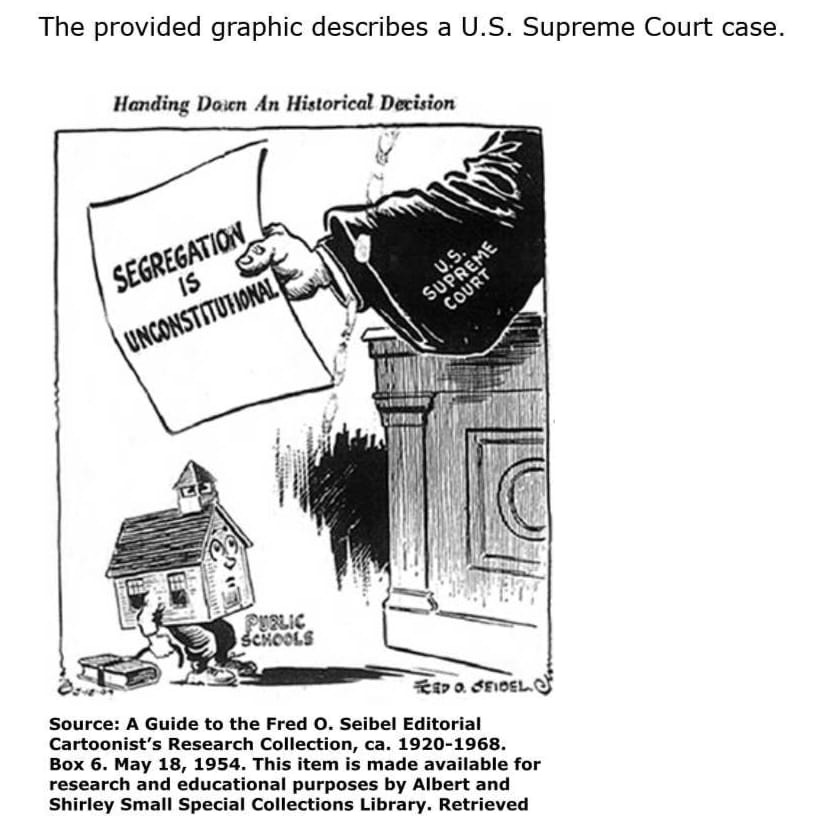
Which U.S. Supreme Court case focuses on the issue presented by the image?
Your Answer: Option(s)
Correct Answer: Option(s) A
Rationale
Brown v. Board of Education addresses the issue presented by the image.
This landmark case from 1954 declared that racial segregation in public schools was unconstitutional, effectively challenging the "separate but equal" doctrine established by Plessy v. Ferguson. The decision played a crucial role in the Civil Rights Movement by promoting equality in education and dismantling segregation laws.
A) Brown v. Board of Education
This case specifically focused on the issue of racial segregation in public education. The Supreme Court unanimously ruled that separate educational facilities are inherently unequal, thus violating the Equal Protection Clause of the Fourteenth Amendment. This pivotal decision laid the groundwork for desegregation efforts across the United States.
B) Dred Scott v. Sandford
This 1857 case dealt with the status of enslaved individuals and their rights under the Constitution. The ruling denied citizenship to African Americans and upheld the legality of slavery, which fundamentally differs from the educational equality issue central to Brown v. Board of Education.
C) Miranda v. Arizona
Decided in 1966, this case established the Miranda rights, requiring law enforcement to inform individuals of their rights during arrest. While it pertains to the rights of suspects in criminal proceedings, it does not address issues of racial segregation or educational equality, which are critical to the question.
D) Mapp v. Ohio
This 1961 case focused on the exclusionary rule, which prevents evidence obtained illegally from being used in court. While significant in protecting Fourth Amendment rights, it is unrelated to the issues of racial segregation in education addressed in Brown v. Board of Education.
Conclusion
Brown v. Board of Education remains a cornerstone of civil rights jurisprudence as it tackled the critical issue of racial segregation in public schools. In contrast, the other cases listed involve different legal principles and contexts, emphasizing the unique significance of Brown in promoting educational equality and civil rights in America.
Select an answer to continue →
Question 4
Which of the following amendments guarantees a trial by jury in all criminal proceedings?
Your Answer: Option(s)
Correct Answer: Option(s) B
Rationale
The Sixth Amendment guarantees a trial by jury in all criminal proceedings.
The Sixth Amendment of the United States Constitution explicitly provides the right to a speedy and public trial by an impartial jury for all criminal prosecutions, ensuring that defendants are afforded this essential legal protection.
A) Fifth Amendment
The Fifth Amendment primarily addresses protections related to due process, double jeopardy, and self-incrimination, but it does not specifically guarantee the right to a trial by jury in criminal cases. Instead, it focuses on legal procedures and rights before trial, making it insufficient for this question.
B) Sixth Amendment
As noted, the Sixth Amendment is the correct choice, as it explicitly enshrines the right to a trial by jury in criminal prosecutions. This amendment ensures that individuals accused of crimes have their cases heard by a jury of their peers, which is a critical component of the American legal system.
C) Seventh Amendment
The Seventh Amendment guarantees the right to a jury trial in civil cases, not criminal ones. While it is an important amendment for civil litigation, it does not apply to criminal proceedings, making it irrelevant to the question asked.
D) Eighth Amendment
The Eighth Amendment primarily prohibits excessive bail, excessive fines, and cruel and unusual punishments. It does not address the right to a trial by jury in either criminal or civil contexts, thus failing to answer the question regarding jury trials.
Conclusion
The right to a trial by jury in all criminal proceedings is explicitly guaranteed by the Sixth Amendment, which is fundamental to ensuring fair legal processes for defendants. The other amendments mentioned—Fifth, Seventh, and Eighth—address different aspects of legal rights and protections but do not encompass the jury trial right in criminal cases. This distinction is crucial for maintaining the integrity of the judicial system in the United States.
Select an answer to continue →
Question 5
Which of the following principles was established by the English Bill of Rights (1689)?
Your Answer: Option(s)
Correct Answer: Option(s) D
Rationale
The privilege to petition the government without fear of retribution.
The English Bill of Rights (1689) affirmed the right of individuals to petition the government, ensuring that citizens could express grievances without the threat of punishment. This principle was a significant step towards establishing civil liberties and limiting the power of the monarchy.
A) The unrestricted authority of the king to suspend laws
This choice contradicts the purpose of the English Bill of Rights, which aimed to limit the powers of the monarchy. The Bill explicitly restricted the king's ability to suspend laws, emphasizing that the rule of law must prevail over arbitrary royal authority.
B) The monarch could levy taxes without Parliament's consent
The Bill of Rights directly opposed this idea by establishing that the monarch could not impose taxes without parliamentary approval. This principle was crucial in the development of a constitutional monarchy where the Parliament held significant power over financial matters.
C) The establishment of a state religion to enforce the monarchy
Rather than establishing a state religion, the English Bill of Rights promoted religious tolerance and limited the monarch's ability to dictate matters of faith. The Bill was a reaction against the previous attempts to enforce religious uniformity, thus reinforcing individual freedoms.
D) The privilege to petition the government without fear of retribution
This principle was indeed established by the English Bill of Rights, allowing citizens to voice their concerns and grievances to the government. This right helped lay the groundwork for modern democratic practices and the protection of individual liberties.
Conclusion
The English Bill of Rights marked a pivotal moment in the establishment of civil liberties, particularly the right to petition the government without fear of retribution. This principle, along with others, helped to curtail the powers of the monarchy and laid the foundation for a government accountable to its citizens, promoting the idea of a constitutional democracy.
Select an answer to continue →
Free Preview Ended
You've seen the first 5 questions.
Subscribe to unlock the remaining 68 questions + full features.