

As an educator who has spent years in the classroom, I have sat across the desk from hundreds of students and worked with teenagers who felt overwhelmed by standard high school environments, adult career-switchers working two jobs to provide for their families, and motivated learners who simply hit a bump in the road years ago and thought their chance at a diploma had passed.
Taking the step to earn your high school equivalency credential is not a sign that you fell behind. It is a bold, courageous decision to build a bridge toward community college, a university degree, trade school, or a higher-paying career path.
What Is the HiSET Exam?
The term HiSET stands for the High School Equivalency Test. The HiSET exam measures whether you have achieved a level of academic accomplishment equivalent to having graduated from high school in the United States. It is officially administered by PSI.
When you pass the HiSET, your state’s department of education awards you an official state high school equivalency diploma or certificate.
Teacher’s Key Insight: HiSET degree is not a “second-class” diploma. In terms of law and practice, the HiSET diploma is treated by the employers, community colleges, four-year universities, vocational schools, and U.S. armed forces like a regular high school diploma.
HiSET vs. GED: What’s the Difference?
Think of the GED and the HiSET as two different brands of cars that take you to the exact same destination. Both test your high school-level knowledge, and both yield an official state-issued equivalency credential. However, there are key structural and logistical differences you should know:
- State Availability: Approximately 20 U.S. states and territories use the HiSET as their primary or alternative high school equivalency exam states like Massachusetts, Louisiana, Iowa, among others. Some states offer both the GED and HiSET, allowing you to choose.
- Paper vs. Computer Options: While the GED is strictly computer-based at official centers, the HiSET offers both computer-based and paper-based testing options in many states. If you struggle with typing or suffer from computer eye fatigue, the option to take a physical paper test with a pencil can be a major stress-reliever.
- Subtest Structure: The GED is split into 4 subject areas - Mathematical Reasoning, Reasoning Through Language Arts, Science, and Social Studies . The HiSET breaks its evaluation into 5 distinct subtests, separating Reading and Writing into two individual exams. Many of my students prefer this because it allows them to focus on one skill at a time.
Section 2: Breaking Down the 5 Subtests
You do not have to take all five tests on the same day. You can space them out, taking one test this week and another next month. I strongly advise against taking them all at once!
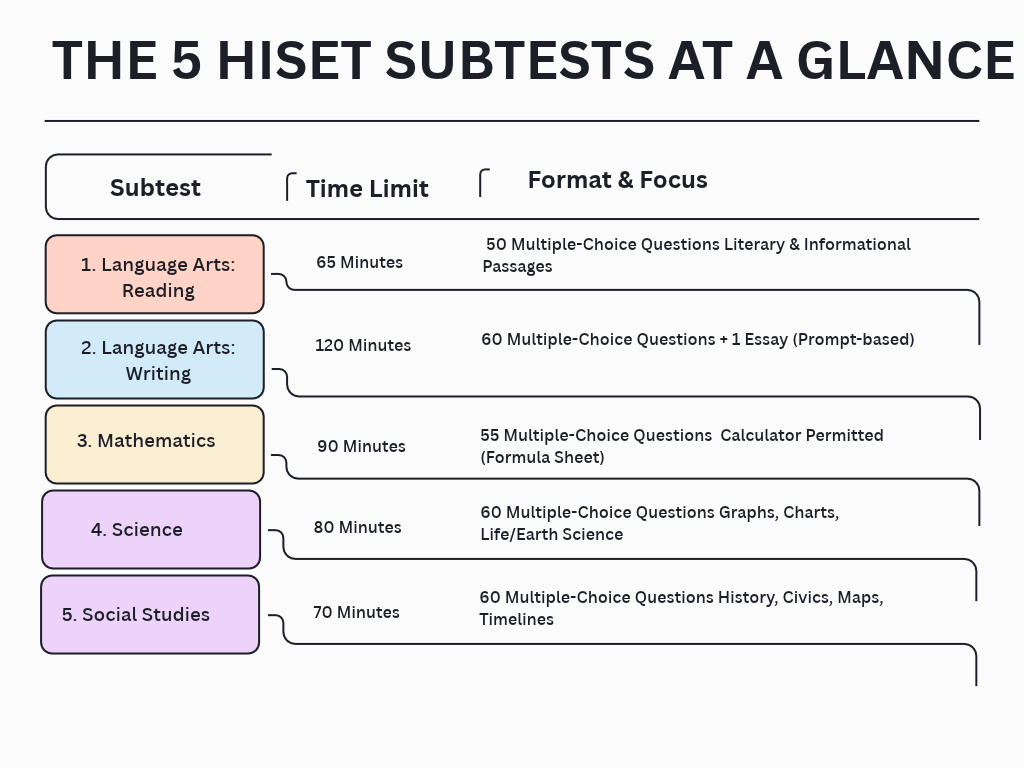
1. Language Arts – Reading
Time Limit: 65 Minutes | Format: 50 Multiple-Choice Questions
The Setup: This is a test of some of the skills involved in understanding what you read. The passages come from a variety of works, both literary and informational.
Core Skills Tested: Passage comprehension, drawing inferences, spotting main ideas, analyzing passage structure, and determining the author's tone.
Teacher’s Pro Tip:The HiSET Reading test is open-book in disguise; every answer is backed by direct evidence inside the text. Practice pointing your finger at the exact line that proves your answer.
2. Language Arts – Writing
Time Limit: 120 Minutes | Format: 60 Multiple-Choice Questions + 1 Essay
Part 1: Editing & Revising (Multiple Choice)
Put on your editor’s hat. You’ll fix grammar errors, improve awkward sentence structures, re-organize messy paragraphs, and correct punctuation.
Part 2: Evidence-Based Essay
You are to write one essay based on two passages provided to you. The passages will provide a topic which will require you to present an argumentative essay. Your essay will be assessed based on how it:Provides convincing reasoning and relevant evidence in support of your argument,Presents ideas clearly and logically,Shows control of language mechanics
Teacher’s Pro Tip: Essay evaluators like structure better than flowery language. Use a basic structure of 4 or 5 paragraphs that include one Introduction that must contain your thesis statement and two body paragraphs .
3. Mathematics
Time Limit: 90 Minutes | Format: 55 Multiple-Choice Questions
This is an examination of your ability to use mathematical principles and solve mathematical questions. Read each question carefully and choose the best answer from the choices provided.
The test usually has:
Numbers & Operations: Fractions, decimals, percentages
Basic Algebra: Solving linear equations, working with variables
Geometry: Area, perimeter, volume, coordinate planes
Data Analysis: Probability, mean/median/mode, reading graphs
Tools Allowed: A formula reference sheet is provided (no need to memorize formulas), along with a physical or on-screen scientific/four-function calculator.
Teacher’s Pro Tip: Algebra is not something to be afraid of. In fact, most of the marks will either be gained or lost in solving word problems and doing calculations.
4. Science
Time Limit: 80 Minutes | Format: 60 Multiple-Choice Questions
The Science section of the assesses your ability to use science content knowledge, apply principles of scientific inquiry, and interpret and evaluate scientific information.
Topics Covered:
Life Science topics: Biological concepts, which include the life cycle and habitat of living things; Cell functions and body systems; Interdependency among living things in an ecosystem; And the relation between the structure and function of living things.
Earth Science topics: Properties of earth materials; Plate tectonics; Movements of the earth in the solar system; And geologic features, cycles, and processes through time.
Physical Science topics : Observable properties of matter such as size, mass, shape, color, and temperature; Forces and ideas about the location and movement of objects; And the nature of light, heat, electricity, and magnetism.
Core Skills Tested: Reading scientific charts, evaluating experimental setups, spotting trends in line graphs, identifying variables, and applying logic.
Teacher’s Pro Tip: Relax, this is not an exam that requires rote memorization. You won't have to know the periodic table or mitosis. In other words, this is a test of your reading skills conducted in a laboratory environment. All you have to do is be able to read graphs and recognize an increasing line on them.
5. Social Studies
Time Limit: 70 Minutes | Format: 60 Multiple-Choice Questions
This section of the assesses your ability to analyze and evaluate various kinds of social studies information
Topics Covered:
Civics and Government themes include the civic values of democracy, the process, role, and significance of informed citizenship, the concepts of power and authority, the features of contemporary and past systems of government, focusing mainly on the U.S. constitution and government, as well as the connection between the rights of individuals and society.
History includes historical sources and points of view; the relationship between past and current events; U.S. history starting from colonialism until now; as well as world history and the political, economic, and cultural aspects of various times.
Topics for Economics are on basic economics concepts and systems; needs and wants; interdependence of economics; and effects of government on the economy.
Geography would include concepts and terminology of both physical and human geography; as well as interpretations of maps and spatial analysis of economic, political, and social aspects.
Core Skills Tested: Analyzing historical speeches, reading political cartoons, interpreting timelines, and deciphering map keys.
Teacher’s Pro Tip: Nobody is going to ask you what date a specific battle took place in 1776. Instead, you'll read a 3-sentence quote from a historical figure and answer why they held that viewpoint. Focus on critical thinking over history trivia.
Section 3: Understanding the Scoring System
Understanding how the HiSET is scored takes the guesswork out of your preparation. You don't need a perfect score; you just need to hit clear benchmarks.
The "Magic" Numbers You Need to Know
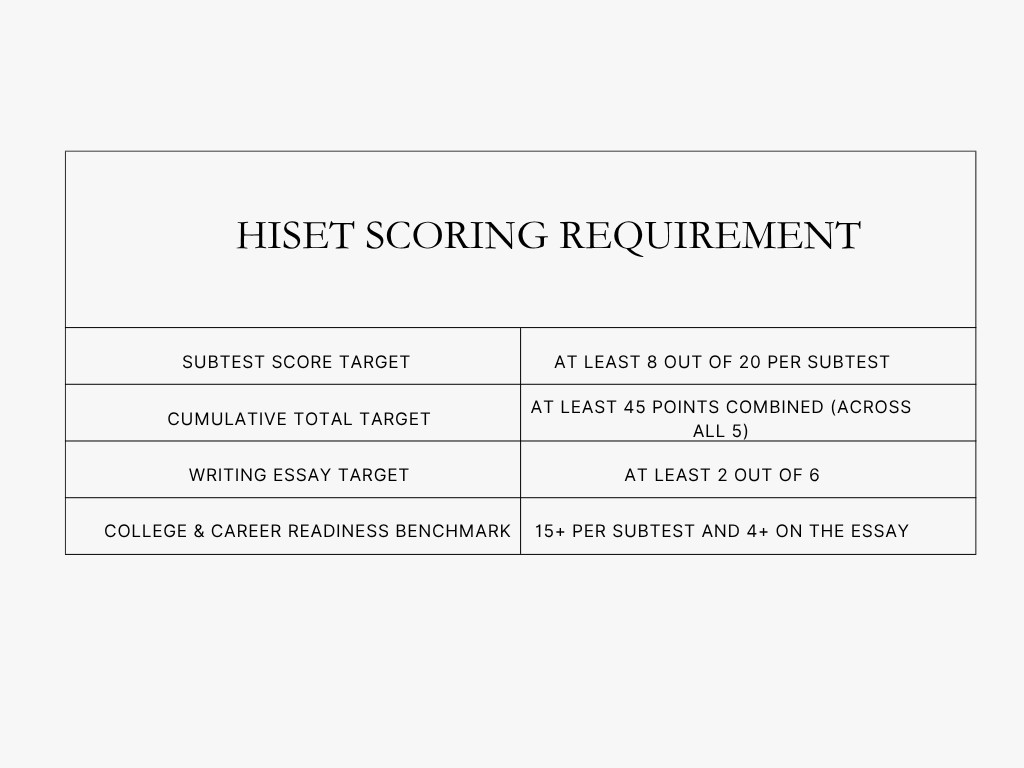
The HiSET uses a scaled scoring system for each subtest:
- 8 out of 20 Minimum: You must score at least an 8 out of 20 on each of the five individual subtests.
- 45 Total Combined Score: Scoring an 8 on all five subtests gives you 40 points, which is not quite enough. You must earn a total combined score of at least 45 points across all five subtests. This means you should aim for a score of 9 or 10 on your strongest subjects to balance out any weaker ones.
- 2 out of 6 on the Essay: On the Language Arts – Writing essay, you must earn a score of at least 2 out of 6.
What Is the College & Career Readiness (CCR) Benchmark?
If you score 15 or higher on any subtest and at least a 4 out of 6 on the essay, you earn the College & Career Readiness (CCR) designation.
What does this mean for you? It signals to community colleges and vocational institutions that you possess college-level academic skills. Many community colleges will honor this score by allowing you to skip remedial, non-credit placement courses and go straight into credit-bearing college classes, saving you hundreds of dollars in tuition!
Section 4: Eligibility & Registration (Practical Action Steps)
Ready to make this official? Taking the administrative steps to sign up can feel daunting, but breaking it down into simple actions makes it easy.
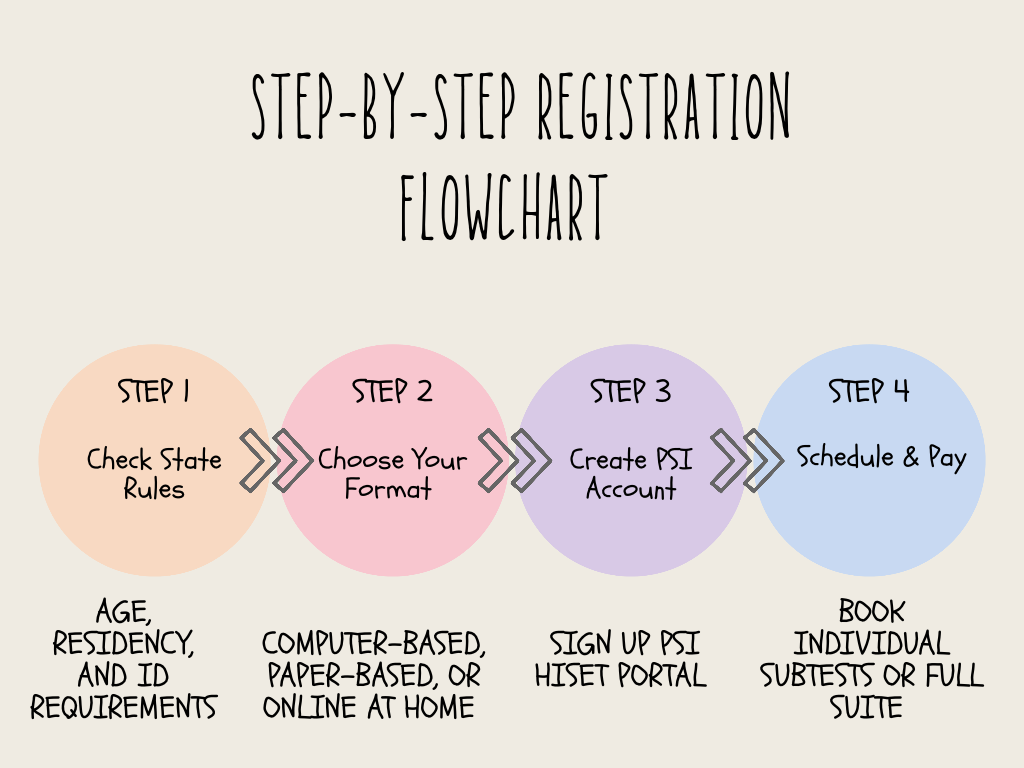
Step 1: Check Your State's Specific Rules
While the HiSET is a national exam, education policy is set by individual states. Before doing anything else, check your state’s specific requirements regarding:
- Age Limits: Most states require you to be 18, but many allow 16- or 17-year-olds to test with official school withdrawal paperwork and parental consent.
- Residency: Some states require you to prove you live in that state before taking the test there.
- Practice Test Requirements: A few states require you to take an official practice test through a local adult education center before registering for the real exam.
Step 2: Choose Your Testing Format
You have options for how and where you take the test:
- In-Person Test Center (Computer): Taken at a local college or testing facility on a desktop computer.
- In-Person Test Center (Paper): Taken at a test center using a physical test booklet and answer sheet.
- HiSET Exam at Home: An online-proctored option that allows you to take the exam on your personal computer in your home, provided you meet strict equipment and room environment rules.
Step 3: Register via the Official Portal
Head to the official PSI HiSET portal to create your account. This dashboard is where you will schedule your test dates, select your testing locations, view your unofficial scores, and order official transcripts once you pass.
Section 5: Actionable Tips for Success
After years of guiding learners through test prep, I have seen what works and what causes unnecessary stress.
Don't Rush All 5 Subtests at Once
The greatest problem that occurs with adult learners is having all five sub-tests done on two consecutive days. With each sub-test, there occurs brain fatigue which leads to errors.
Strategy: Take the HiSET test in steps, not leaps. Take one to two subtests at a time. Begin with your best subtest whether it be reading or social studies because you need to make it through at least one subtest for a good start. Once done, you will gain great confidence .
Take a Diagnostic First
Before wasting your money on expensive study guides or classes online, try a free practice HiSET exam.
A diagnostic exam is like a map. It tells you precisely what you already know and where your weaknesses are. If you perform well in Science without even studying, then you know for sure that you don’t need to spend three weeks learning about science. Instead, you will be able to concentrate entirely on Math and/or Writing.
Utilize Free Local & Online Resources
You do not need to spend hundreds of dollars to pass this exam.
- Adult Basic Education (ABE) Centers: Almost every county or municipality offers free adult education classes funded by state grants. These programs provide free instruction, prep books, and sometimes even testing fee vouchers!
- Public Libraries: Your local library card gives you free access to test prep databases like LearningExpress Library, which includes full-length practice HiSET exams.
- Official HiSET Website: PSI offers downloadable sample test questions and scoring rubrics for free.
Focus on Strategy Over Memorization
For subtests like Science, Social Studies, and Reading, test-taking strategy beats brute-force memorization every single time.
- Process of Elimination: Every question has four options. Usually, two are obviously wrong. Eliminating those two immediately increases your odds of getting the right answer to 50%.
- Read the Questions First: When tackling long reading or science passages, read the question prompts before reading the text. This tells your brain exactly what information to search for while reading.
Section 6: Closing & Call to Action (Keeping the Spark Going)
Taking the HiSET is an investment in your future self.
It takes genuine courage to step back into the world of education as an adult or career-switcher. Every hour you spend studying, every practice question you solve, and every subtest you pass brings you one step closer to that promotion, that college degree, or that new career path you have been dreaming about.
Be patient with yourself, celebrate every small win along the way, and remember that thousands of students before you have stood right where you are standing today and made it across the finish line. You can do this too.