
When Data Learns to Speak: My Journey into Nursing Informatics
It was 3:00 AM on a Tuesday, my feet were throbbing, and I was staring down a mountain of digital chart notes that felt higher than Mount Everest. I had just spent twenty minutes fighting with a frozen computer screen, clicking through seven sub-menus just to log a single set of routine vital signs. I remember leaning back in my chair, taking a slow breath, and thinking: I went to nursing school to care for human beings, not to spend my entire shift acting as a full-time clerk for a stubborn computer program.
That night of deep documentation frustration was my turning point. It was the moment I realized that technology in healthcare was sick and it desperately needed a nurse's care.
In those early hours, I stopped looking at our computer systems as cold, mechanical boxes. Instead, I started viewing Data as a patient. Just like the person lying in Bed 4, our clinical data was sitting quietly in a crowded waiting room, overflowing with important things to say, but lacking the voice or system to say them. It had crucial stories to tell about lab trends, subtle temperature spikes, and medication histories, but no one had designed a clear way to listen.
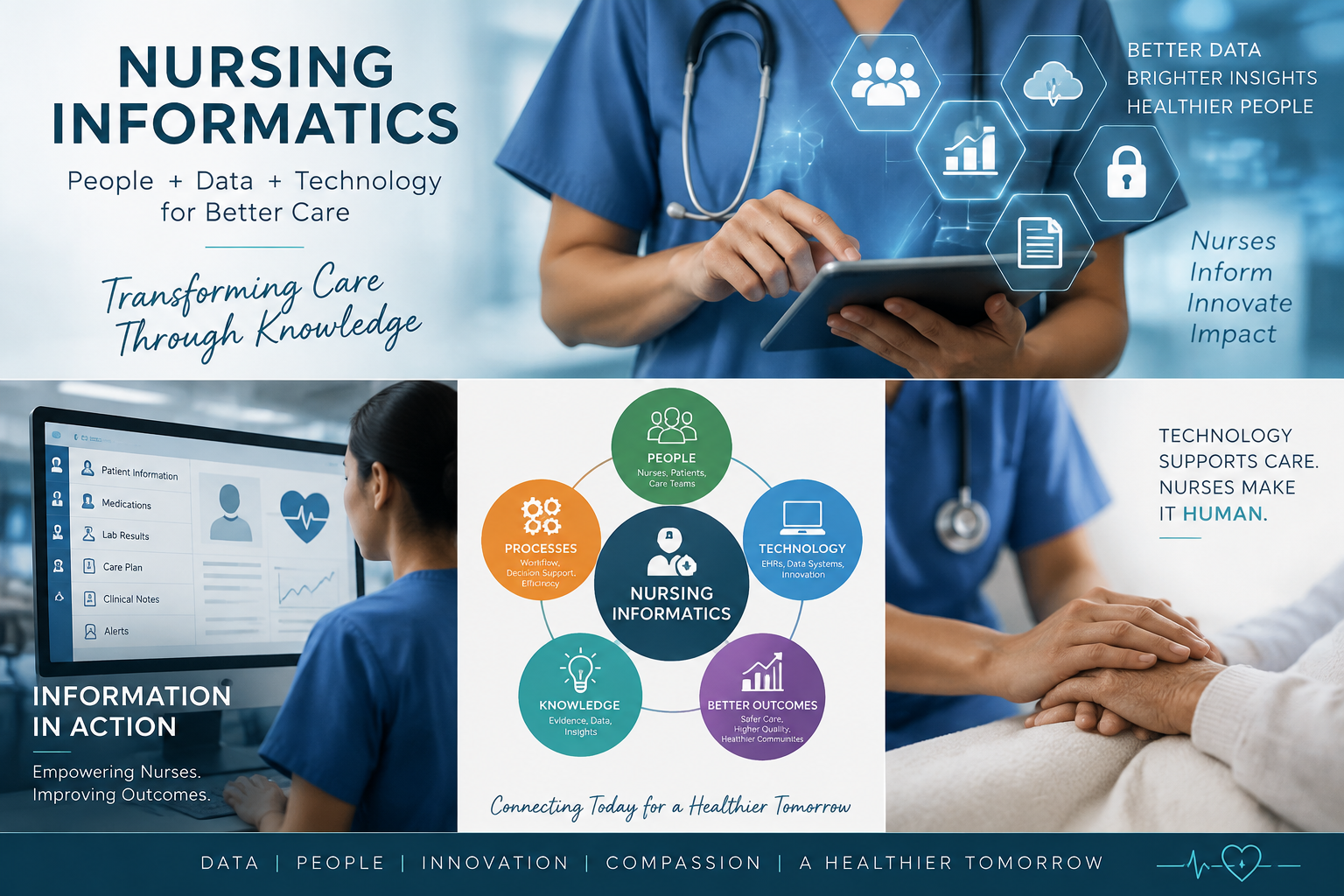
That realization led me straight to Nursing Informatics. In everyday terms, Nursing Informatics is simply the discipline where caring for people meets the power of smart technology. It is the art and science of turning raw numbers into meaningful tools that actually help clinicians heal.
What Is Nursing Informatics?
Strip away the heavy technical jargon, and Nursing Informatics is simply the intersection where caring for patients meets the power of smart health technology.
It is the specialty that integrates nursing science with computer and information science to manage and communicate data, information, knowledge, and wisdom in nursing practice. In everyday terms, it is the discipline dedicated to making sure healthcare technology actually works for nurses and patients not against them.
Instead of treating technology as a separate chore you complete after giving care, informatics transforms technology into an active partner. It takes raw, messy clinical numbers blood pressure readings, lab results, allergy records and organizes them into actionable insights that help clinicians make safer, faster, and smarter decisions at the bedside.
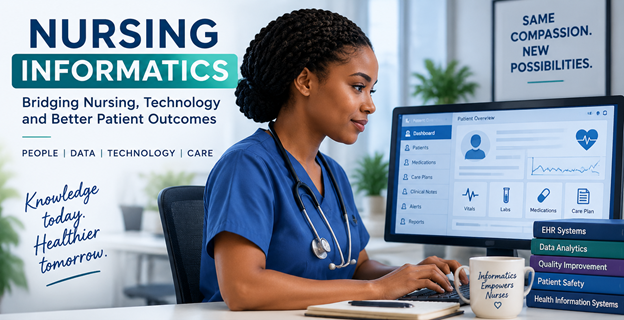
What Informatics Is Made Of
Nursing Informatics isn't just "nurses who like computers." It is a specialized practice where three distinct worlds overlap at the bedside to keep care safe, efficient, and compassionate:
- Nursing Science (The Heart and Intuition): This brings the hands-on clinical wisdom, critical thinking, and real-world empathy of patient care to the table.
- Information Science (The Mind and Structure): This governs how we capture, organize, store, and retrieve medical knowledge so it makes total sense when a clinician needs it most.
- Computer Science (The Engine and Infrastructure): This provides the software platforms, hardware devices, database logic, and secure networks that power daily health systems.
When these three elements work in harmony, technology stops feeling like a barrier and starts feeling like an extension of your nursing judgment. Without Nursing Science, software stays rigid and impractical. Without Information and Computer Science, clinical wisdom remains trapped on paper or isolated in individual minds.
What a Nurse Informaticist Actually Does
The single best way to describe a Nurse Informaticist is as a Translator.
Software developers speak fluent code, and bedside nurses speak fluent clinical care. When developers try to build software without a nurse in the room, you end up with systems that look great in a boardroom demonstration, but completely fall apart during a chaotic 2:00 AM trauma admission. We step into that space to translate clinical needs into technical specifications.
Here is what that work looks like in practice every day:
- EHR Optimization: We redesign clunky Electronic Health Record screens so nurses can document care in fewer clicks, keeping their attention focused on the patient.
- Workflow Design: We analyze unit routines to ensure technology fits naturally into how care is actually delivered, eliminating redundant charting steps.
- Safety Alert Tuning: We fine-tune automated system alerts to eliminate alert fatigue, ensuring nurses only get interrupted when a warning is genuinely critical.
- Barcoded Safety Systems: We implement and test Barcode Medication Administration (BCMA) systems to make sure the right patient gets the right medication and dosage every single time.
Why Nursing Informatics Matters for Patient Care
At its core, Nursing Informatics is about giving "Data" a clear, confident voice. When data learns to speak up, patient care transforms from reactive charting into proactive healing.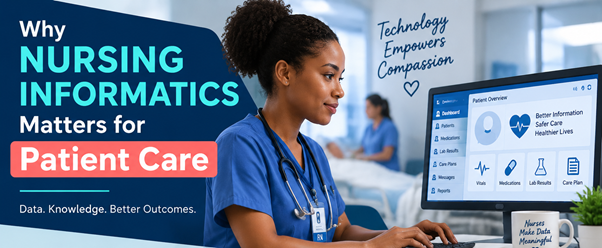 Here is what happens when data gets to join the care team:
- Data as the Early Warning Signal: Imagine a patient developing sepsis. Traditionally, we might not catch it until high fevers or crashing blood pressure force us to react. But when data speaks, it whispers in our ear much earlier. It points out that a slight bump in heart rate paired with a subtle drop in urine output over four hours isn't random--it's an early alarm. An automated algorithm flags the pattern, letting us intervene hours before overt shock sets in.
- Data as the Safety Co-Pilot: It's 5:00 AM, you're exhausted, and you're administering a complex medication. Relying purely on manual cross-checking under fatigue is a heavy burden to carry alone. Informatics gives the medication bottle and the patient's wristband their own voices through barcode scanning. If you grab the wrong vial, the system speaks up instantly: "Stop, wrong dose." It turns near-misses into zero-harm moments
- Data as the Time Saver: We didn't enter nursing to spend three hours post-shift re-keying the same vitals into three different screens. Integrated, standardized flowsheets let medical devices talk directly to the chart. By letting data log itself, we shave dozens of repetitive minutes off documentation every shift--giving us back the time we need to sit with our patients, listen to their concerns, and deliver genuine human care.
When we listen to what our systems are telling us, we stop reacting to emergencies after they happen and start preventing them before they begin.
How to Get Started in the Field
If you are a bedside nurse who finds yourself constantly thinking, "There has to be a smarter way to design this workflow," you already have the mindset of an informaticist. Bridging into health IT doesn't happen overnight, but you can start right where you are:
- Become a Unit "Super-User": Volunteer to be the go-to person on your unit whenever your facility updates software or rolls out new medical devices.
- Join Practice Committees: Participate in shared governance, quality improvement, or clinical technology committees at your hospital.
- Master Clinical Workflows: Deepen your understanding of how different hospital departments pharmacy, lab, radiology, and bedside nursing exchange information.
- Pursue Specialized Education & Certification: Look into Master of Science in Nursing (MSN) programs in Health Informatics or work toward credentials like the ANCC Nursing Informatics Certification (NI-BC).
Embrace the Technology That Serves Your Care
Technology will never replace the warm touch, keen intuition, or empathetic ear of a dedicated nurse. It was never meant to.
Instead, Nursing Informatics exists to make sure technology serves as an extension of your care giving a powerful tool that clears away clutter, quiets noise, and gives data a voice. When we embrace smart systems, we don't lose the human touch in nursing we gain the time and clarity needed to deliver it best.
Ready to Turn Your Clinical Wisdom into Tech Expertise? Don't let clunky software slow down your passion for care. Whether you're exploring a Master’s in Nursing Informatics or preparing for your ANCC Nursing Informatics Certification.