

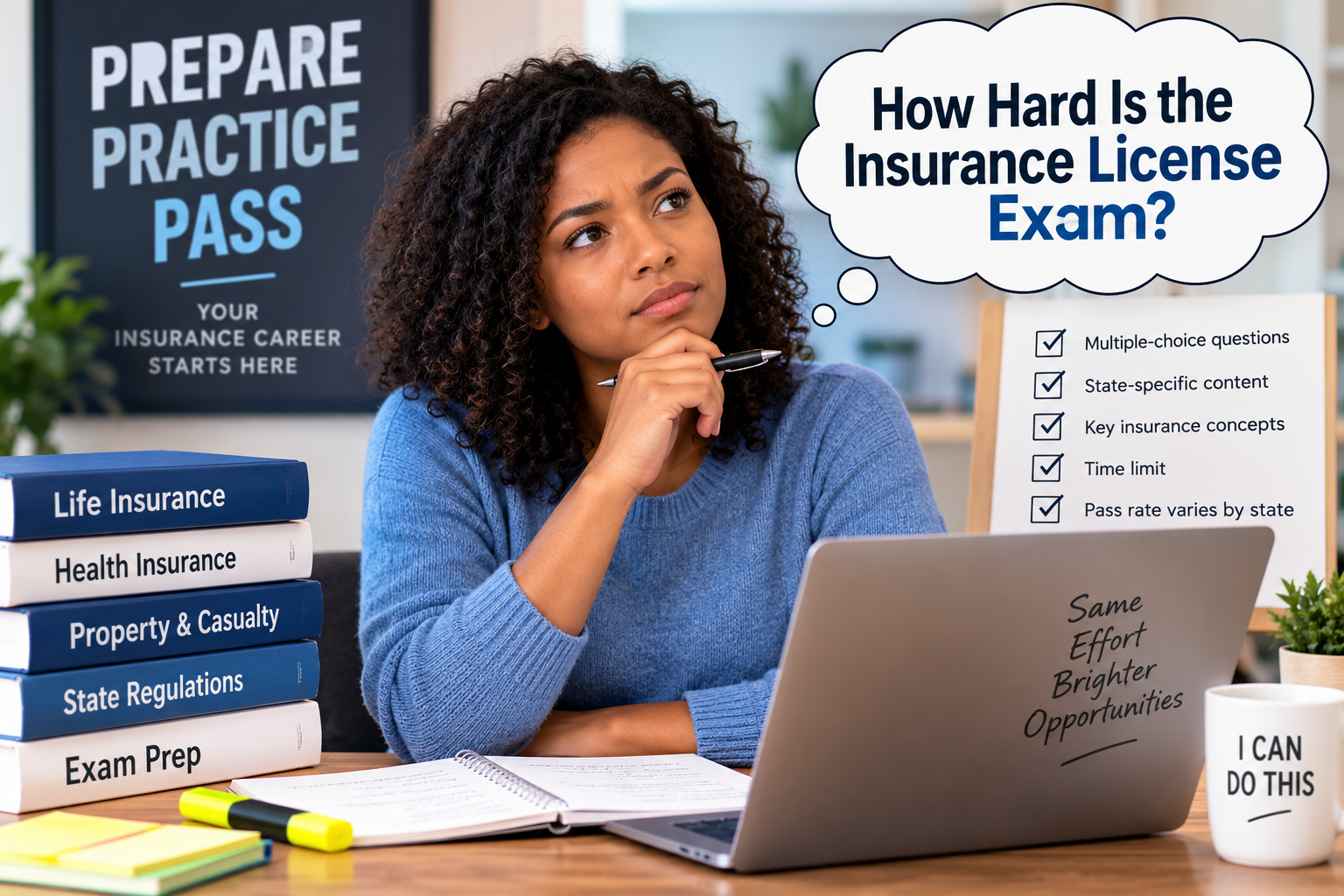
How Hard Is the Insurance License Exam? 
When I first started looking into getting my insurance license, I kept hearing two completely different stories. Some people told me, "Oh, it’s just a basic state test, you can study for a few days and walk right through it." Others looked like they hadn't slept in weeks, warning me about sneaky trick questions and endless legal jargon.
So, what’s the real truth? How hard is the insurance license exam, really?
If you are standing at the starting line of your insurance career, I am going to give you the honest breakdown no sugarcoating, but no fear-mongering either. More importantly, I'm going to share the exact strategies you need so you can pass on your very first attempt.
How Hard Is the Exam, really?
Let’s start with the cold, hard numbers. First-time pass rates for insurance licensing exams generally hover between 50% and 60% depending on your state and the specific license line.
That statistic surprises a lot of people. Because you don’t need a specialized college degree to take the exam, many candidates make the mistake of underestimating it. They walk in expecting basic common-sense questions, only to get blindsided by the depth of the material.
Here is why the exam gives so many test-takers a hard time:
1. It’s Like Learning a Whole New Language
Insurance isn't just about understanding policies it's about mastering specific terminology. Terms like subrogation, indemnity, co-insurance, and aleatory contracts aren't part of everyday conversation. If you don't know the exact definition of a word, answering a question built around it becomes almost impossible.
2. The Question Wording Can Be Tricky
The exam creators love double negatives, scenario-based prompts, and options where two answers seem correct except one is slightly more accurate based on policy wording. You aren't just tested on what you know; you are tested on how carefully you read.
3. State-Specific Rules Will Catch You Off Guard
While general insurance principles apply across the board, every state has its own specific statutes, regulations, ethics rules, and licensing requirements. This section forces you to memorize exact numbers, deadlines, and penalty amounts.
The Major Insurance Licensing Exams (Why People Fail & How to Pass Each)
Not all insurance exams are created equal. Depending on the career path you choose, you'll take one or more of these major exams. Here is a breakdown of what makes each test uniquely challenging and how to beat it.
1. Life Insurance Exam
This exam covers term life, whole life, universal life, annuities, and policy riders.
Why You Can Fail It: Candidates often fail because they confuse the nuances of cash-value growth, tax implications, and annuity payouts. Memorizing rider names without understanding when they kick in e.g., accelerated death benefit vs. waiver of premium is a classic pitfall.
How to Pass: Draw comparison tables for cash-value policy types and annuity settlement options. Pay heavy attention to beneficiary designations and tax treatment rules those account for a huge chunk of scenario questions.
2. Health Insurance Exam
This test focuses on individual/group medical plans, disability coverage, Long-Term Care (LTC), Medicare, and ACA regulations.
Why You Can Fail It: The overwhelming amount of medical jargon and federal regulation. Test-takers frequently mix up Medicare parts A, B, C, D or miscalculate coinsurance/deductible out-of-pocket maximums under pressure.
How to Pass: Focus on mathematical scenario questions dealing with claims payout splits deductibles, copays, coinsurance ratios. Create flashcards dedicated solely to Medicare eligibility timelines and group health conversion rights.
3. Property & Casualty (P&C) Exam
Generally considered the toughest of the core producer exams, P&C covers homeowners, auto, commercial property, general liability, and workers' compensation.
Why You Can Fail It: The vast scope of material. You have to balance personal coverage rules with complex commercial policies, liability thresholds, and legal concepts like negligence and umbrella policies.
How to Pass: Master policy declarations and exclusion sections. Learn the core difference between named perils and open perils early on, and drill commercial property coverage forms until they become second nature.
4. Personal Lines Exam
A limited-scope version of P&C that focuses strictly on non-commercial policies auto, home, renters, personal liability.
Why You Can Fail It: Candidates treat it like a "light" exam and don't study enough. While easier than full P&C, it still tests heavy state laws, valuation methods (Actual Cash Value vs. Replacement Cost), and endorsement rules.
How to Pass: Don't underestimate it Focus heavily on standard HO policy types HO-2, HO-3, HO-5 and auto liability limits split e.g., 25/50/25 coverage rules.
5. Claims Adjuster Exam
Required for professionals who inspect damage, evaluate claims, and negotiate settlements on behalf of insurers or policyholders.
Why You Can Fail It: The exam is heavily scenario-driven and tests deep policy interpretation, valuation math, and strict legal claims handling timelines.
How to Pass: Practice calculating actual cash value ACV = Replacement Cost - Depreciation and study state claims handling timelines strictly. Understand the legal duties of an adjuster during a dispute.
What You Need to Do to Pass
Now for the good news the insurance exam is 100% passable if you approach it with the right strategy. You don't need to be a genius you just need to study smarter. Here is my step-by-step game plan to conquer it.
1. Focus on Concepts, Not Just Memorization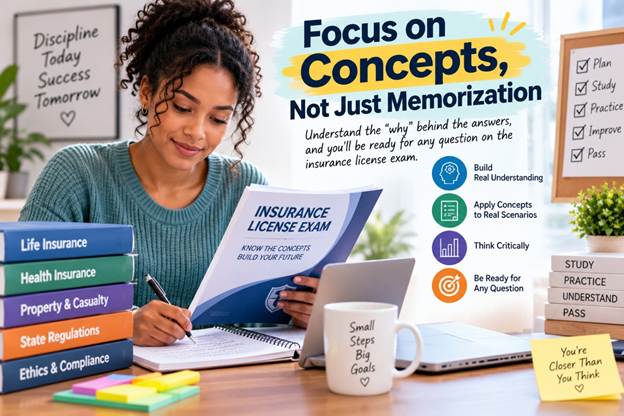
Don't just memorize definitions off flashcards. The state exam rarely asks, "What is the definition of X?" Instead, it presents a story: "Client A has Policy B and experiences Event C. How much does the insurer pay?" Make sure you understand why a rule exists and how it works in a real-world scenario.
2. Drill Practice Exams Until You Get 85%+ Consistently
If there is one secret weapon, this is it. Taking practice tests does two critical things:
- It gets your brain used to the tricky, indirect phrasing of exam questions.
- It helps you identify your weak spots so you aren't wasting time studying topics you've already mastered.
Pro Tip: Don't just look at what you got wrong read the answer rationales for every question to understand the logic behind the correct choice.
3. Give State-Specific Content Extra Love
When you get your exam breakdown outline, pay attention to the state law module. Many candidates pass the general principles section with flying colors but fail the whole exam because they skimped on state regulations. Dedicate solid time to memorizing local grace periods, commissioner powers, and continuing education rules.
4. Space Out Your Prep (Ditch the Cramming)
Give yourself roughly 2 to 3 weeks of consistent, daily studying about 1 to 2 hours a day, totaling around 30–40 hours. Cramming 30 hours of dense legal and policy concepts over a single weekend is a recipe for brain overload. Consistent exposure builds long-term retention
.
Hard Work Beats a Hard Exam
Is the insurance license exam hard? Yes, it takes real effort and solid preparation. But is it an impossible hurdle? Absolutely not. Treat it like a serious professional milestone, stick to a structured study routine, and drill those practice exams.
Before you know it, you'll be putting that license on your desk and launching your new career. You've got this. Feeling overwhelmed by state laws and policy jargon? Don't stress. Grab our Insurance Exam Survival Checklist to get a study roadmap, key terms cheat sheet, and state-law flashcards.