


As a Registered Nurse and Nurse Educator, if there is one skill I consistently see bridging the gap between textbook theory and real-world clinical confidence, it is phlebotomy. Venipuncture is often a student's very first hands-on procedure involving invasive patient care. It is a vital, high-demand skill that serves as a core foundation across almost every acute and outpatient setting in modern healthcare.
When I mentor nursing students and other health care professionals during their clinical placements, those who are CPT certified really make a mark for themselves. These individuals have a certain level of ease when it comes to identifying patients, vein selection, and specimen collection that takes the others many months to achieve.
As an aspiring phlebotomist, a pre-nursing candidate looking to stand out on program applications, or a current nursing student building your practical portfolio, passing the CPT exam is a major professional milestone.
What the CPT Exam Entails
Several reputable organizations offer phlebotomy certification likes of the American Society for Clinical Pathology (ASCP), the American Medical Technologists (AMT), and the National Center for Competency Testing (NCCT) but the National Healthcareer Association (NHA CPT) framework is one of the most widely recognized across hospitals and outpatient facilities.
The framework entails that Total Questions are 120 total items (100 scored items and 20 unscored, pre-test items used by the testing board for future exam validation).The time fairy allotted is 2 hours or 120 minutes. Passing standard that are accepted is a Scaled score of 390 out of 500 - for the NHA exam.
Eligibility & Clinical Requirements
It goes without a say, you must fulfill foundational academic and clinical prerequisites.
- Academic Baseline: A high school diploma, GED equivalent, or higher degree.
- Training Pathway: Graduation from an accredited phlebotomy training program within the past 5 years, or at least 1 year of supervised, full-time phlebotomy work experience.
- Hands-on Mandate: Verified documentation of at least 30 successful venipunctures and 10 capillary (finger/heel) sticks performed on live human subjects. Simulated practice on rubber arms alone will not satisfy this requirement.
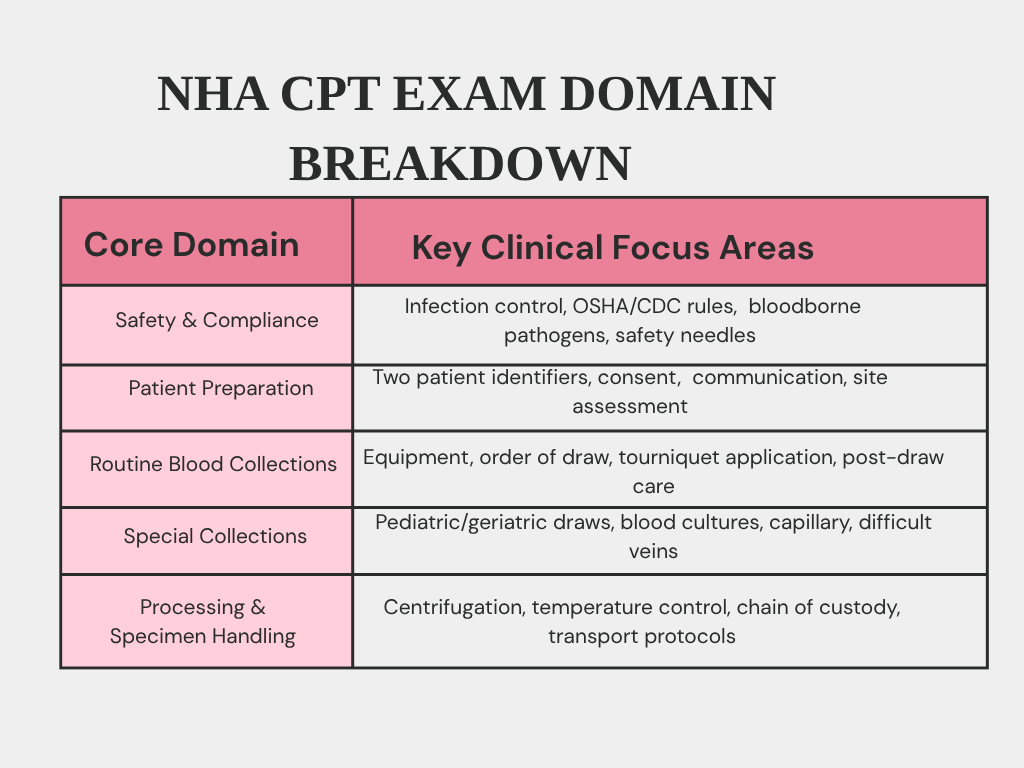
Core Test Domains
For you to align your study time with the actual distribution of test questions, understand the breakdown of the exam.
- Safety and Compliance: Focuses heavily on Universal Precautions, OSHA standards, proper Disposal of Biohazard Waste, and Personal Protective Equipment (PPE). Expect scenario questions regarding exposure incidents and needle safety devices.
- Patient Preparation: Examines your ability to verify patient identity using at least two unique identifiers like full name and date of birth, obtain informed or implied consent, explain procedures clearly to reduce anxiety, and assess arm site suitability.
- Routine Blood Collections: Covers proper equipment selection (gauge sizes, vacutainer tubes, butterfly needles), tourniquet application time (maximum 1 minute to avoid hemoconcentration), site cleansing protocols, and strict adherence to the Order of Draw.
- Special Collections: Addresses specialized procedures such as blood cultures (requiring strict sterile technique to prevent skin flora contamination), neonatal screening, capillary blood gas sampling, and geriatric considerations for fragile veins.
- Processing and Specimen Handling: Evaluates post-collection handling, including centrifugation speeds, light-sensitive specimens (e.g., bilirubin), chilled samples (e.g., ammonia, lactic acid), and chain of custody documentation for forensic or drug screening draws.
Section 2: How to Prepare Before the Exam
Structured 3- to 4-Week Study Plan
Cramming 120 minutes of technical clinical knowledge into a single weekend rarely leads to long-term retention. As an educator, I advise candidates to commit to a structured timeline ,at least a 3- to 4-week timeline. Aim for 45 to 60 minutes of daily, focused study rather than exhausting marathon sessions. Short, consistent study intervals significantly improve memory consolidation.
High-Yield Content Areas to Master
1. Order of Draw Memorization
Cross-contamination of tube additives is one of the most frequently tested concepts on the CPT exam. You must know the exact order of draw, the primary additive in each tube, and the laboratory department to which the tube travels.
Draw Order | Tube Top Color | Additive / Mechanism | Common Tests / Department |
1 | Yellow / Blood Culture | SPS (Sodium Polyanethol Sulfonate) or Broth Media | Blood Cultures, Microbiology |
2 | Light Blue | Sodium Citrate (Anticoagulant) | Coagulation Studies (PT, PTT, INR) |
3 | Red / SST (Gold/Tiger) | Clot Activator / Separator Gel | Comprehensive Metabolic Panel (CMP), Lipid, Chemistry |
4 | Green | Heparin (Lithium or Sodium) | STAT Chemistry, Electrolytes, Ammonia |
5 | Lavender / Purple | EDTA (Chelates Calcium) | Complete Blood Count (CBC), ESR, Hematology |
6 | Gray | Sodium Fluoride & Potassium Oxalate | Glucose tolerance, Lactic Acid, Blood Alcohol |
2. Complications and Prevention
- Hemolysis: Destruction of red blood cells caused by using too small a needle (e.g., smaller than 23 gauge for routine draws), shaking tubes vigorously instead of gently inverting them, or pulling back too quickly on a syringe plunger.
- Hemoconcentration: Increased concentration of larger molecules and blood cells caused by leaving the tourniquet on longer than 60 seconds.
- Hematoma: Blood leaking into surrounding tissue due to bevel misplacement, penetrating the vein's back wall, or failing to release the tourniquet before withdrawing the needle.
- Syncope (Fainting): Recognizing early warning signs (pallor, sweating, slurred speech), stopping the procedure immediately, removing the needle, safeguarding the patient's head, and applying cool compresses.
3. Applied Anatomy & Physiology
You must understand the vascular anatomy of the antecubital fossa. The median cubital vein is your primary choice due to its stability and size. The cephalic vein is your second choice (ideal for obese patients), while the basilic vein is your last choice due to its proximity to the brachial artery and median nerve.
Educator-Approved Study Techniques
Active Recall and Spaced Repetition: Study using flashcards by quizzing yourself on additives in tubes and inversion counts.
Practice Test Taking with Rationale Review: It is important not to grade yourself based on your score percentage alone. It is crucial to understand the rationale behind all the answer choices, including the ones you have answered correctly.
Visual and Tactical Help: Make your own drawing of veins in antecubital fossa. Also make your own chart with colored highlighting for tube tops using different highlighters.
Exam Week Preparation
As your test date approaches, ensure your logistics are in order:
- Documentation: Gather two forms of government-issued identification, your test admission pass, and completed clinical draw logs signed by your program director or instructor.
- Online vs. In-Person Testing: If utilizing Live Remote Proctoring (LRP) at home, perform system checks 48 hours in advance, clear your testing space of all papers and extra monitors, and ensure a stable internet connection. If testing at a Pearson VUE or NHA center, plan to arrive 20 to 30 minutes early to complete check-in.
Section 3: What to Do Right After the Exam
Immediate Steps & Results
Once you submit your exam, you will usually receive an unofficial pass/fail notification on screen or at the test center desk. Official scaled score reports are generally posted to your online account portal within 24 to 48 hours.
If You Passed
- Claim Digital Credentials: Download your official wallet card and digital badge through the certifying board's portal.
- Update Professional Documentation: Add your new credentials (CPT) next to your name on your resume, cover letter, and LinkedIn profile.
- Notify Employers & Educators: Send your updated verification link to your academic advisors or hiring managers.
If You Need to Retake
- Review Score Reports: The board provides a domain-by-domain diagnostic breakdown. Use this report to target your review sessions on specific weak areas.
- Retake Timelines: Certifying agencies require a mandatory waiting period between attempts (typically 30 days for the second attempt). Use this period for deliberate practice rather than taking the exam again immediately.
Maintaining Certification
Your phlebotomy credential is an active clinical document that requires periodic renewal:
- Continuing Education (CE): For the NHA CPT, you must complete 10 Continuing Education credits every 2 years and pay a renewal fee to keep your status active.
- Log Your Hours: Keep track of your clinical practice hours and CE certificates in a dedicated professional folder.
Section 4: The Future & Career Growth After Certification
Immediate Employment Settings
Holding a phlebotomy certification opens doors across a variety of healthcare settings:
- Inpatient Hospital Units: Rapid-paced environments involving emergency room, intensive care unit, and morning routine floor draws.
- Outpatient Clinics & Diagnostic Labs: High-volume, structured settings such as Quest Diagnostics or Labcorp.
- Blood Donation Centers: Focusing on large-bore needle access, donor screening, and automated apheresis procedures.
- Mobile Phlebotomy Services: Providing home visits for homebound patients, insurance physicals, or specialized clinical research trials.
Stackable Credentials & Career Ladders
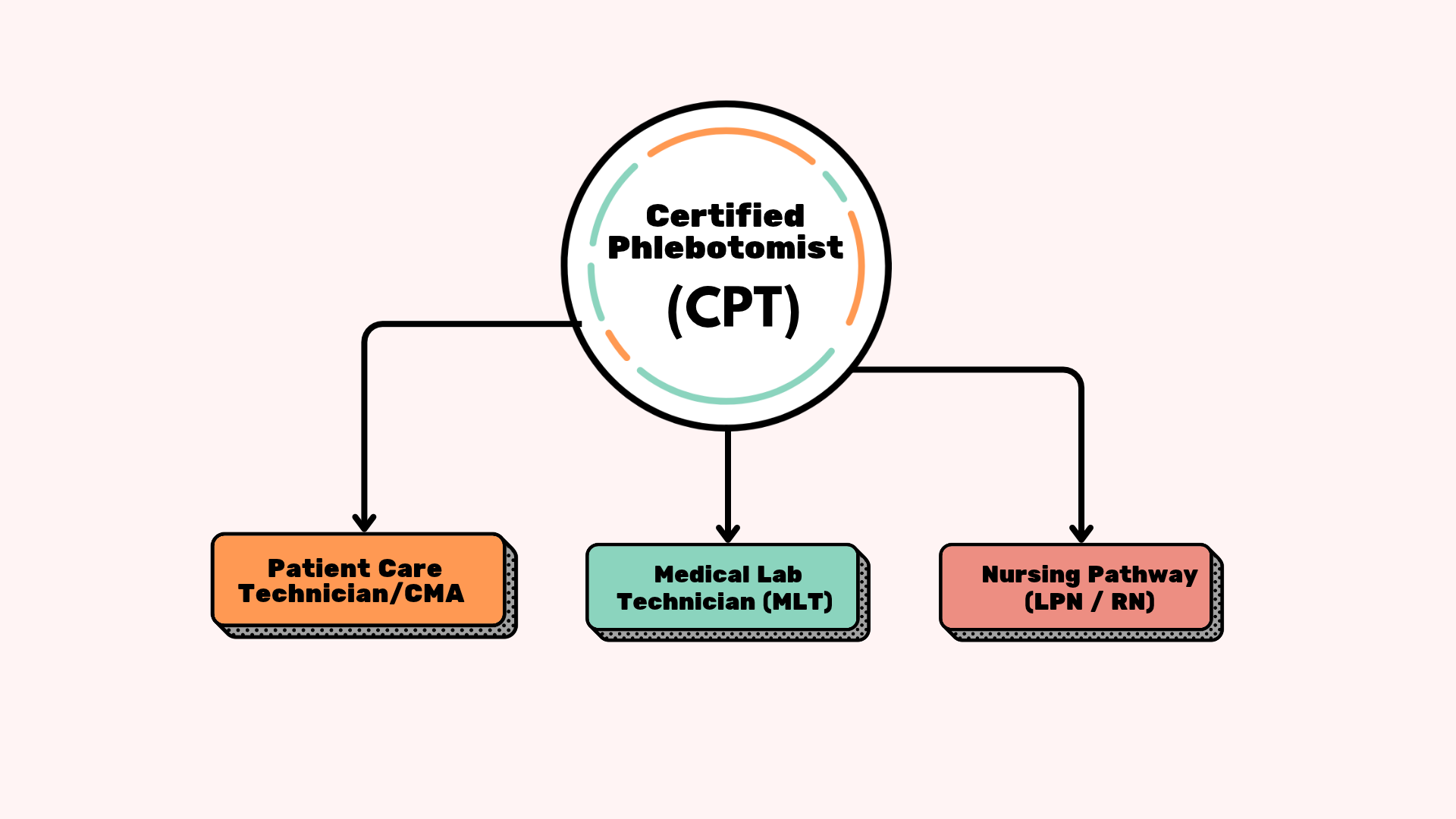
A phlebotomy certification is one of the most effective "stackable credentials" in modern healthcare education:
- Patient Care Technician (PCT) / Certified Medical Assistant (CMA): Combining phlebotomy with EKG technician (CET) or Certified Nursing Assistant (CNA) certifications makes you highly versatile in emergency departments and urgent care centers.
- Medical Laboratory Technician (MLT) / Clinical Laboratory Scientist (CLS): For students interested in the diagnostic side of medicine, starting in phlebotomy provides firsthand insight into specimen collection, quality control, and laboratory processing.
- Nursing Progression (LPN / RN / BSN): For pre-nursing and nursing students, working as a phlebotomist offers early clinical experience. You will develop confidence in interacting with patients, assessing fragile veins, overcoming needle phobia, and operating within hospital protocols. When you begin your nursing clinical rotations, IV insertions and blood draws will feel natural rather than intimidating.
Soft Skills & Professional Impact
Beyond technical competency, being a great phlebotomist requires deep human empathy. Patients are frequently anxious, needle-phobic, or in pain. Developing a calm bedside manner, mastering the art of distraction, maintaining active listening, and providing clear instruction are professional skills that will serve you throughout your entire healthcare career.
Conclusion
Getting your Certified Phlebotomy Technician certification means that you need to put in the effort, have the skills, and provide care with empathy. Be it that phlebotomy is a lifelong career for you or it is a crucial step towards your career as a Registered Nurse or laboratory worker, the things you learn here are going to pay off in the long run.
Take this preparation step by step, focus on understanding the clinical rationales behind every draw order and safety protocol, and approach your exam with confidence.