
Which of the following parts contain cells targeted by antidiuretic hormones (ADH)?
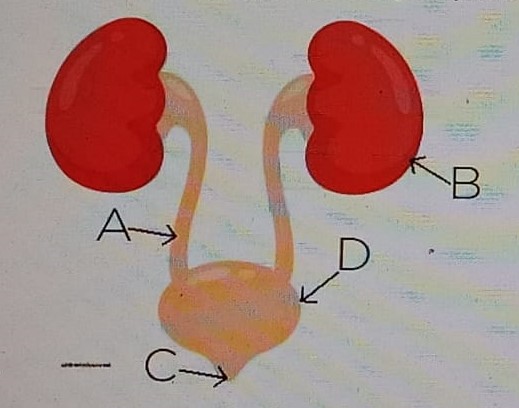
Part B contains cells targeted by antidiuretic hormones (ADH).
Antidiuretic hormone (ADH), also known as vasopressin, primarily targets the cells in the kidneys, specifically in the collecting ducts, to promote water reabsorption and concentrate urine. Part B represents this critical region where ADH exerts its primary physiological effects.
Part A does not contain the specific cells targeted by ADH. Instead, it may refer to an area of the nephron or another structure that does not play a direct role in the action of ADH. The primary effects of ADH are not elicited in this region, making it an incorrect choice.
Part B is the correct answer because it contains the cells in the collecting ducts of the nephrons which respond to ADH. These cells have aquaporin channels that allow for increased water permeability when ADH binds, thereby facilitating the reabsorption of water back into the bloodstream.
Part C likely refers to an area unrelated to the action of ADH. While it may play a role in renal function, it does not house the specific cell types responsive to ADH. Therefore, it cannot be the correct answer as it does not participate in the regulation of water balance in response to this hormone.
Part D also does not contain the targeted cells for ADH. Similar to parts A and C, it may be involved in renal processes but lacks the specific functionality related to ADH action. Thus, it is not relevant to the question regarding the hormone's target cells.
In summary, the cells targeted by antidiuretic hormones (ADH) are primarily located in the collecting ducts of the kidneys, represented by Part B. The other options, A, C, and D, do not contain these specific cells and therefore do not participate in the actions of ADH. Understanding the precise locations and functions of hormonal action is crucial in the study of renal physiology and fluid balance.
Related Questions
View allIf a portion of a strand of DNA bases reads 5' AGCTAGGGT 3', what woul...
Which of the following planes divides the body into left and right hal...
Which of the following would increase the rate of an endothermic react...
Which of the following structures is present in both prokaryotic and e...
The following processes causes most of the carbon dioxide from the blo...
Related Quizzes
View allATI TEAS 7 English Practice Test
ATI TEAS 7 English and Language Usage
ATI TEAS 7 English and Language Usage Practice Test
ATI TEAS 7 English and Language
TEAS 7 English Practice Test Free
Free ATI TEAS 7 Math Practice Test
ATI TEAS 7 Math Practice Questions
ATI TEAS 7 Math Practice Test
ATI TEAS 7 Math Exam 2
ATI TEAS 7 Practice Test Math
- ✓ 500+ Practice Questions
- ✓ Detailed Explanations
- ✓ Progress Analytics
- ✓ Exam Simulations