
The lesson objective is most likely that students will understand which of the following about comparing fractions?
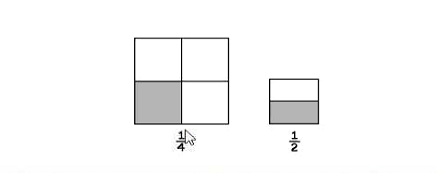
The fractions should refer to the same whole.
Understanding that fractions must refer to the same whole is essential for accurately comparing their sizes. When fractions share a common denominator, it allows for a direct comparison of their numerators, facilitating a clear understanding of which fraction is larger or smaller.
While having the same shape for shaded parts can help in visually comparing fractions, it is not a requirement for understanding their relative sizes. The critical aspect of comparing fractions lies in their relationship to a common whole, rather than the geometry of the shaded areas.
This statement is incorrect because the size of a fraction is not solely determined by its denominator. A smaller denominator indicates that the whole is divided into fewer parts, but without considering the numerator, one cannot conclude that the fraction is larger. For example, 1/2 is larger than 1/3, but 1/4 (with a smaller denominator) is not larger than 1/3.
This is the correct answer as comparing fractions requires that they pertain to the same whole to accurately assess their values. When fractions are based on different wholes, their comparative size cannot be determined meaningfully.
While it is true that when fractions are compared, the wholes should generally be divided into equal parts for accurate comparison, this statement does not capture the primary objective of the lesson. The emphasis should be on ensuring that fractions refer to the same whole, as this directly relates to their comparability.
The objective of the lesson on comparing fractions centers on the requirement that fractions must refer to the same whole. This foundational understanding allows students to make accurate comparisons between different fractions. While equal parts and shapes may assist in visual understanding, they are secondary to the necessity of a common whole for meaningful comparison.
Related Questions
View allWhich of the following would be the most appropriate step for the teac...
Which of the following is a true statement about Earth’s moon?
Which of the following math skills is the child developing during the...
A third-grade teacher decides to have students rate their classmates a...
Which of the following is the correct order for the stages in the life...
Related Quizzes
View allPraxis 5001 Test with Answers
Praxis 5002 Study Guide
5002 Praxis Practice Test
Reading & Language Arts Praxis 5002
Praxis 5002 Reading and Language Arts Exam
Praxis 5003 Exam with Outline
5003 Praxis Math Answers
Praxis 5003 Study Guide
Praxis Social Studies 5004
Praxis 5004 Social Studies
- ✓ 500+ Practice Questions
- ✓ Detailed Explanations
- ✓ Progress Analytics
- ✓ Exam Simulations