
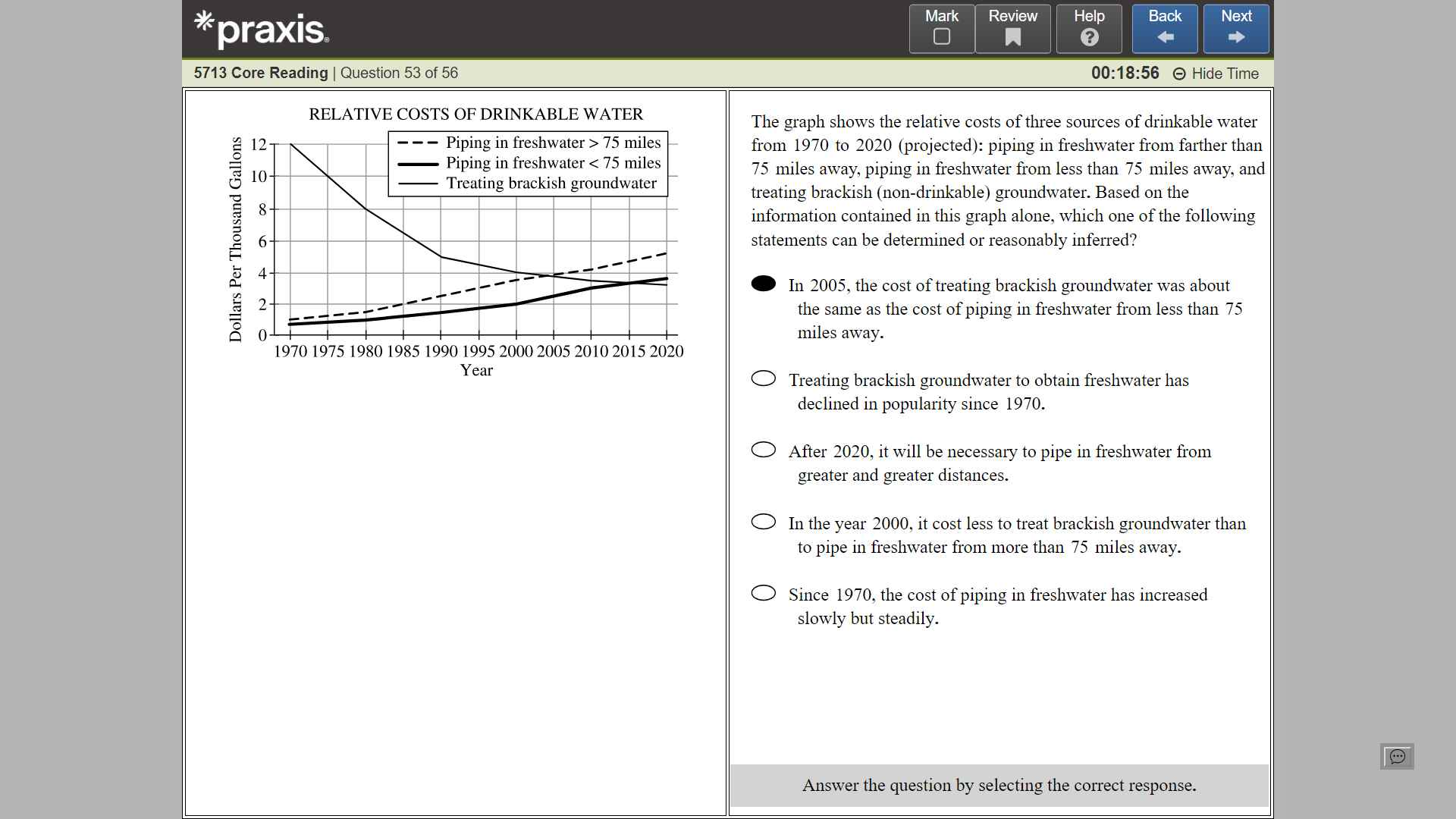
The graph shows the relative costs of three sources of drinkable water from 1970 to 2020 (projected): piping in freshwater from farther than 75 miles away, piping in freshwater from less than 75 miles away, and treating brackish (non-drinkable) groundwater. Based on the information contained in this graph alone, which one of the following statements can be determined or reasonably inferred?
In 2005, the cost of treating brackish groundwater was about the same as the cost of piping in freshwater from less than 75 miles away.
The graph indicates that in 2005, the costs of both treating brackish groundwater and piping in freshwater from less than 75 miles were approximately equal, allowing this conclusion to be drawn directly from the data presented.
This statement accurately reflects the data in the graph, which shows that the two costs converged around the same value in 2005. This shared cost level can be directly observed in the visual representation of the data.
The graph does not provide information regarding the popularity or usage trends of treating brackish groundwater; it only presents cost data. Therefore, this statement cannot be inferred from the given information.
The graph does not project future trends beyond 2020 that would indicate a necessity for increasing distances for piping freshwater. Hence, this statement cannot be reasonably inferred from the information provided.
The graph shows that in 2000, the cost of treating brackish groundwater was higher than the cost of piping in freshwater from more than 75 miles away. Therefore, this statement is incorrect based on the data.
While the graph may indicate trends in cost, it does not specify that the increase has been steady, nor does it provide enough information to confirm this assertion definitively. Thus, this statement cannot be reliably inferred.
The only statement that can be conclusively supported by the graph is that in 2005, the costs of treating brackish groundwater and piping in freshwater from less than 75 miles were about the same. Other options either lack necessary data, make assumptions beyond the graph's scope, or are inaccurate interpretations of the information presented.
Related Questions
View allThe author of the passage would be most likely to agree with which of...
The author of the passage cites Maxine Hong Kingston most likely in or...
The purpose of the sentence in lines 9 - 11 ('Buck had . . . Chinese c...
The passage suggests which of the following as a reason for the comple...
The primary purpose of the passage is to
Related Quizzes
View allPraxis 5001 Test with Answers
Praxis 5002 Study Guide
5002 Praxis Practice Test
Reading & Language Arts Praxis 5002
Praxis 5002 Reading and Language Arts Exam
Praxis 5003 Exam with Outline
5003 Praxis Math Answers
Praxis 5003 Study Guide
Praxis Social Studies 5004
Praxis 5004 Social Studies
- ✓ 500+ Practice Questions
- ✓ Detailed Explanations
- ✓ Progress Analytics
- ✓ Exam Simulations