
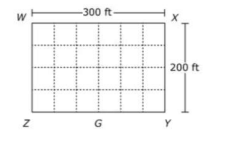
Laura walks every evening on the edges of a sports field near her house. The field is in the shape of a rectangle 300 feet (ft) long and 200 ft wide, so 1 lap on the edges of the field is 1,000 ft. She enters through a gate at point G, located exactly halfway along the length of the field.
Laura counts the number of strides she takes during her daily walks. She takes about 80 strides to walk the width of the field from Z to W. Assuming that her stride length does not change, about how many strides does Laura take to walk all the way around the edge of the field?
Laura takes about 400 strides to walk all the way around the edge of the field.
Since the perimeter of the rectangular field is 1,000 feet and Laura takes approximately 80 strides to cover the 200-foot width, we can calculate her stride length as 2.5 feet. To find the total number of strides for the entire perimeter, we divide the total distance (1,000 feet) by her stride length (2.5 feet), resulting in approximately 400 strides.
This option underestimates the number of strides Laura would take. If we assume a stride length of 2.5 feet, dividing the total distance of 1,000 feet by this stride length gives a much larger number than 267. Thus, this choice does not accurately reflect her walking distance.
Choosing 320 strides also fails to account for the total distance Laura covers. When calculating with the stride length of 2.5 feet, the result will not yield 320 strides, indicating a miscalculation in determining either the stride length or total distance walked around the field.
This option overestimates the number of strides Laura takes. A stride length of 2.5 feet means that Laura would take approximately 400 strides to cover the 1,000-foot perimeter of the field. Therefore, 450 strides is not a feasible count for her walk around the field.
This is the correct choice because it accurately reflects Laura's stride count based on her stride length and the total distance of the perimeter. With 1,000 feet to cover and each stride measuring 2.5 feet, Laura takes around 400 strides, which aligns perfectly with the calculations.
By determining Laura's stride length from her width stride count, we can accurately assess her total strides around the rectangular field. The calculation confirms that she takes about 400 strides, making this the only correct response. Each of the other options fails to align with the established measurements and calculations, reinforcing the reliability of the correct answer.
Related Questions
View allA bag of dog food weighs 40 pounds. The amount of food in the bag is m...
The daily cost, C(x), tor a company to produce x microscopes is given...
Simplify: (3x - 5) + (-7x + 2)
Which graph shows a line described by 4x - 3y = 12?
Two men are employed at a local supermarket. The table shows James's e...
Related Quizzes
View allGED Mathematical Reasoning
GED Mathematical Reasoning Answers
GED Reasoning Through Language Arts
GED Reasoning Through Language Arts Practice Test
GED Science Sample Test
GED Science Test Prep
Sample GED Social Studies Test
Social Studies GED Test
- ✓ 500+ Practice Questions
- ✓ Detailed Explanations
- ✓ Progress Analytics
- ✓ Exam Simulations