
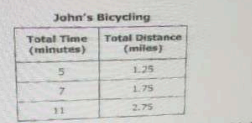
John and Mike are participating in a long-distance bicycling event. Mike bicycled 24 miles in the first 2 hours. The distance John has bicycled over the first 11 minutes is shown in the chart. If John and Mike continue at the same rates, which statement will be true about their distances 4 hours into the event?
Mike will be 12 miles ahead of John.
Mike's cycling rate is 12 miles per hour, while John's rate is significantly slower. If both maintain their respective speeds over the next 4 hours, the distance difference will result in Mike being 12 miles ahead of John after the event duration.
This option suggests that John outpaces Mike, which is incorrect. Given Mike's speed of 12 miles per hour and John's slower pace, there is no scenario where John can be ahead after 4 hours. John’s speed does not allow for a lead over Mike.
This statement is also false. For John to be 12 miles ahead, he would need to ride significantly faster than Mike, which is not the case. With Mike traveling at 12 miles per hour, it is impossible for John, riding at a slower speed, to achieve this lead.
While this choice indicates Mike is ahead, the distance difference after 4 hours is greater than 6 miles. With Mike bicycling at 12 miles per hour, he will cover 48 miles in 4 hours, while John will cover much less, resulting in a lead greater than 6 miles.
This is the correct statement. After 4 hours, Mike will have traveled 48 miles. If John’s distance covered in that time is significantly less, Mike's lead will be exactly 12 miles, given the difference in their cycling rates.
In a long-distance bicycling event, maintaining a consistent speed is crucial. Mike's faster cycling rate ensures that he will be 12 miles ahead of John after 4 hours, based on their respective speeds. John's slower pace guarantees that he cannot close this gap, confirming Mike's lead.
Related Questions
View allThe weight of a red blood cell is about 4.5 X 10*11 grams. A blood sam...
What is the slope of a line perpendicular to the line given by the equ...
The owner of a small cookie shop is examining the shop's revenue and c...
Last weekend, 625 runners entered a 10,000-meter race. A 10,000- meter...
The equation and the graph represent two linear functions. Function P...
Related Quizzes
View allGED Mathematical Reasoning
Mathematical Reasoning GED
GED Reasoning Through Language Arts
GED Reasoning Through Language Arts Practice Test
GED Science Sample Test
GED Science Test Prep
Sample GED Social Studies Test
Social Studies GED Test
- ✓ 500+ Practice Questions
- ✓ Detailed Explanations
- ✓ Progress Analytics
- ✓ Exam Simulations