
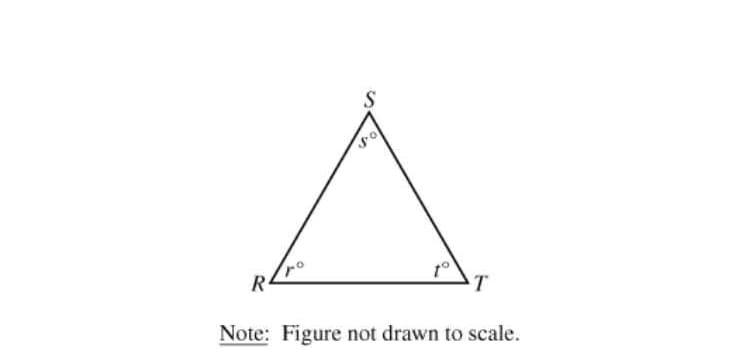
In triangle RST above, RS = RT. Which of the following must be true?
s = t
In triangle RST, where RS = RT, the property of isosceles triangles dictates that the angles opposite the equal sides must also be equal. Therefore, the angles at points S and T, denoted as s and t, must be equal, confirming that s = t.
This statement does not need to be true. In an isosceles triangle, the lengths of the base (ST) can differ from the lengths of the equal sides (RS and RT). Therefore, while ST can be equal to RS in some cases, it is not a requirement.
This choice is incorrect because the relationship between the sides does not dictate that RT must be greater than ST. Depending on the specific dimensions of triangle RST, RT could be equal to, less than, or greater than ST.
This statement is true as it reflects the property of isosceles triangles, where the angles opposite the equal sides are equal. Since RS = RT, the angles at S and T, labeled s and t, must indeed be equal.
This is not necessarily true, as the angle at R (r) can be less than, equal to, or greater than the angles at S and T (s and t). The relationship between these angles is not strictly defined without specific measures.
This statement is also not guaranteed. The angles in triangle RST do not have a defined order solely based on the side lengths, and s could be less than, equal to, or greater than r.
In triangle RST, the equality of sides RS and RT directly leads to the conclusion that the angles opposite these sides, s and t, must be equal. Therefore, s = t is the only statement that must hold true, while the other options present relationships that are not guaranteed by the properties of isosceles triangles.
Related Questions
View allA drawing of a certain park is made to scale so that 1 centimeter repr...
Last week a bookstore ordered a total of 92 books. The number of scien...
A bag contains 12 identical pieces of paper, each of which has a diffe...
Jill and Craig are each reading a copy of the same book. So far, Jill...
According to the flowchart above, if M = -17 and P = 10, what answer w...
Related Quizzes
View allPraxis 5001 Test with Answers
Praxis 5002 Study Guide
5002 Praxis Practice Test
Reading & Language Arts Praxis 5002
Praxis 5002 Reading and Language Arts Exam
Praxis 5003 Exam with Outline
5003 Praxis Math Answers
Praxis 5003 Study Guide
Praxis Social Studies 5004
Praxis 5004 Social Studies
- ✓ 500+ Practice Questions
- ✓ Detailed Explanations
- ✓ Progress Analytics
- ✓ Exam Simulations