
In the figure shown, segment DC in triangle ACD is extended to point B. Which of the following angles is an obtuse angle?
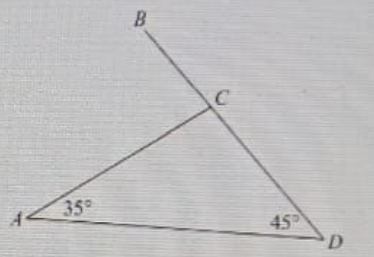
∠ACD is an obtuse angle.
In triangle ACD, extending segment DC to point B results in angle ∠ACD being greater than 90 degrees. This makes ∠ACD the only angle among the provided options that is classified as obtuse, as it exceeds the right angle threshold.
Angle ∠CAD is formed by segment AC and segment AD. Since triangle ACD consists of interior angles that sum to 180 degrees, and considering that angle ∠ACD is obtuse, angle ∠CAD must be acute and therefore cannot be obtuse.
Angle ∠ACD is formed at vertex C between the segments AC and CD. As stated, extending segment DC to point B makes angle ∠ACD greater than 90 degrees, categorizing it as an obtuse angle. This angle is the only one in the options that possesses this property.
Angle ∠ADC is located at vertex D between segments AD and DC. Since it is an interior angle of triangle ACD, and the sum of the angles in a triangle is always 180 degrees, ∠ADC, along with the other angles, must be acute to accommodate the obtuse angle ∠ACD.
Angle ∠ACB is an exterior angle formed by extending segment DC. However, this angle is supplementary to angle ∠ACD and does not exceed 180 degrees. Given that it is adjacent to an obtuse angle, it remains acute and cannot be classified as obtuse.
In triangle ACD, the extension of segment DC to point B causes angle ∠ACD to be the only obtuse angle among the options provided. The other angles, ∠CAD, ∠ADC, and ∠ACB, are either acute or supplementary to the obtuse angle and, therefore, do not meet the criteria for being classified as obtuse. This understanding of angle classification is essential in geometric analysis and problem-solving.
Related Questions
View allWhich of the following statements is true?
A ruler with a position marked with an arrow is shown in the figure. W...
The first four terms of an arithmetic sequence are shown. Which of the...
Which of the following statements is true about the dependent variable...
In the number shown, which of the following is the value of the underl...
Related Quizzes
View allPraxis 5001 Test with Answers
Praxis 5002 Study Guide
5002 Praxis Practice Test
Reading & Language Arts Praxis 5002
Praxis 5002 Reading and Language Arts Exam
Praxis 5003 Exam with Outline
Praxis 5003 Study Guide
Praxis Social Studies 5004
Praxis 5004 Social Studies
Praxis 5004 Social Studies Subtest Practice Test
- ✓ 500+ Practice Questions
- ✓ Detailed Explanations
- ✓ Progress Analytics
- ✓ Exam Simulations