
Daniel is planning to buy his first house. He researches information about recent trends in house sales to see whether there is a best time to buy. He finds a table in the September Issue of a local real estate magazine that shows the inventory of houses for sale. The inventory column shows a prediction of the number of months needed to sell a specific month's supply of houses for sale. The table also shows the median sales price for houses each month.
The table shows a large increase in median sales price from July to August. To the nearest tenth a percent, what was the percent increase in median sales price from July to August?
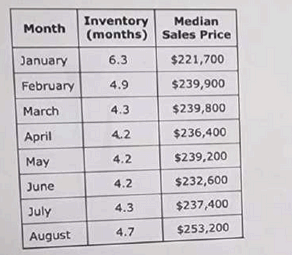
To the nearest tenth of a percent, the percent increase in median sales price from July to August was 14.2.
To calculate the percent increase, the formula used is \(\frac{\text{New Value} - \text{Old Value}}{\text{Old Value}} \times 100\). Applying this formula to the median sales prices for July and August results in a percent increase of 14.2%.
This choice suggests a higher percent increase than calculated. A percent increase of 15.8% would imply a greater change in median sales price than what was observed from July to August, showing a misunderstanding of the actual values involved.
This option indicates a significantly lower increase and does not reflect the actual rise in median sales price. A 6.2% increase would imply that the price change was minimal, which contradicts the data showing a large increase from July to August.
This is the correct answer, calculated based on the difference in median sales prices for July and August. The calculation confirms that the median sales price indeed increased by 14.2% during this period, accurately reflecting the observed data.
This choice also underrepresents the actual increase in median sales price. A 6.7% increase suggests only a slight change, whereas the data indicates a much larger rise in prices between the two months.
The percent increase in median sales price from July to August was calculated as 14.2%, making option C the correct choice. Other options either overestimate or underestimate the actual change, highlighting the importance of accurate calculations when interpreting market trends in real estate. Understanding these trends can significantly impact decisions like buying a house.
Related Questions
View allLisa is decorating her office with two fully stocked aquariums. She sa...
Lisa is decorating her office with two fully stocked aquariums. She sa...
A scale drawing of a truck has a length of 3 inches (in.), as shown be...
The mass of an amoeba is approximately 4.0 X 10^(-6) grams. Approximat...
For an emergency service call, a plumbing company charges a flat fee o...
Related Quizzes
View allGED Mathematical Reasoning Answers
Mathematical Reasoning GED
GED Reasoning Through Language Arts
GED Reasoning Through Language Arts Practice Test
GED Science Sample Test
GED Science Test Prep
Sample GED Social Studies Test
Social Studies GED Test
- ✓ 500+ Practice Questions
- ✓ Detailed Explanations
- ✓ Progress Analytics
- ✓ Exam Simulations