
At what point does the function stop decreasing and start increasing?
(1, -4)
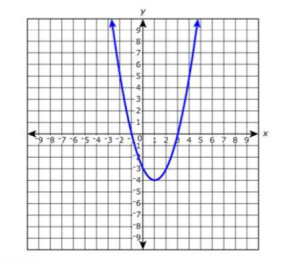
The function stops decreasing and starts increasing at the point (1, -4), which is the local minimum of the function. This point indicates a transition from a decreasing slope to an increasing slope, reflecting a change in the behavior of the function.
This point is the correct answer because it represents the local minimum where the function changes its direction from decreasing to increasing. At this coordinate, the derivative of the function equals zero, indicating a critical point that signifies the end of a decreasing interval and the beginning of an increasing interval.
This point does not represent a local minimum or maximum for the function. Instead, it may be part of an increasing segment of the function, where the function is still increasing rather than stopping its decrease. Thus, it does not indicate a point where the function transitions from decreasing to increasing.
This point is not relevant in the context of the function's behavior regarding decreasing and increasing intervals. It may be a point on the curve, but it does not indicate a transition point from a decreasing to an increasing function. It could represent a point of increase or a plateau, depending on the function's overall trend.
At this point, the function is still decreasing before reaching the local minimum at (1, -4). Therefore, it does not mark the transition from decreasing to increasing; rather, it is part of the interval where the function is still falling.
The point (1, -4) is where the function transitions from decreasing to increasing, marking the local minimum. Understanding such critical points is key in calculus for analyzing the behavior of functions, particularly in determining intervals of increase and decrease. The other options do not fulfill this criterion and thus do not represent valid transition points.
Related Questions
View allAcceleration, a, in meters per second squared (m/s²), is found by the...
The width of a painting is 24 centimeters shorter than its length, x....
The radius of the sphere below is 6 centimeters (cm). What is the volu...
Fix It Fast is an auto repair shop that employs 10 mechanics. Each day...
A shipping box for a refrigerator is shaped like a rectangular prism....
Related Quizzes
View allGED Mathematical Reasoning
GED Mathematical Reasoning Answers
GED Reasoning Through Language Arts
GED Reasoning Through Language Arts Practice Test
GED Science Sample Test
GED Science Test Prep
Sample GED Social Studies Test
Social Studies GED Test
- ✓ 500+ Practice Questions
- ✓ Detailed Explanations
- ✓ Progress Analytics
- ✓ Exam Simulations