
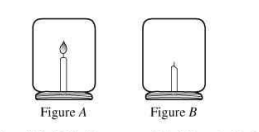
A lit candle is attached to a jar lid, and the lid is then screwed tightly onto the jar as shown in Figure A. The mass of the jar with the candle burning inside it is determined. When the flame extinguishes, the candle and jar appear as in Figure B. When the jar and candle as shown in Figure B are weighed, the new mass
The new mass will be the same as the original mass.
When the candle burns inside the jar, it converts wax into gases (like carbon dioxide and water vapor), which remain trapped in the jar when the lid is sealed. After the flame extinguishes, the total mass of the jar and the remaining substances inside, including the unburned wax and gases, will equal the mass measured when the candle was still burning.
This choice suggests that some mass has been lost during the burning process. However, according to the law of conservation of mass, the total mass of a closed system (like the jar) remains constant, as all products of combustion are contained within the jar.
This option incorrectly implies that additional mass has been gained after the candle burns. In reality, although gases are produced, they are part of the closed system and do not contribute to an increase in mass; thus, this choice is incorrect.
The mass remains unchanged because all the materials (wax, gases) produced during combustion are contained within the jar. The mass of the remaining candle, the gases, and the jar will equal the initial mass measured when the flame was burning.
This choice suggests that the absence of the flame affects our ability to measure mass. However, the state of the candle (burning or extinguished) does not affect the mass of the closed system, so this option is misleading.
The mass of the jar with the burning candle and after the candle has extinguished remains the same due to the conservation of mass in a closed system. All products of combustion are contained, and therefore, weighing the jar after the candle has gone out will yield the same mass as when it was lit, confirming that no mass has been lost or gained in the closed jar system.
Related Questions
View allThe populations of towns W, X, and Z are shown. Which of the following...
A tariff increase on imported steel is most likely to preserve the job...
A bird flying eastward through the sky suddenly drops a peanut it was...
If one student were to be randomly selected from the 35 students in Mr...
Which of the following organisms lays its eggs in water?
Related Quizzes
View allPraxis 5001 Test with Answers
Praxis 5002 Study Guide
5002 Praxis Practice Test
Reading & Language Arts Praxis 5002
Praxis 5002 Reading and Language Arts Exam
Praxis 5003 Exam with Outline
5003 Praxis Math Answers
Praxis 5003 Study Guide
Praxis Social Studies 5004
Praxis 5004 Social Studies
- ✓ 500+ Practice Questions
- ✓ Detailed Explanations
- ✓ Progress Analytics
- ✓ Exam Simulations