
A full Moon will be observed from Earth when the Moon is located in which of the positions shown in the preceding figure? (Position 1: between Sun and Earth; Position 2: first quarter; Position 3: opposite Sun; Position 4: third quarter)
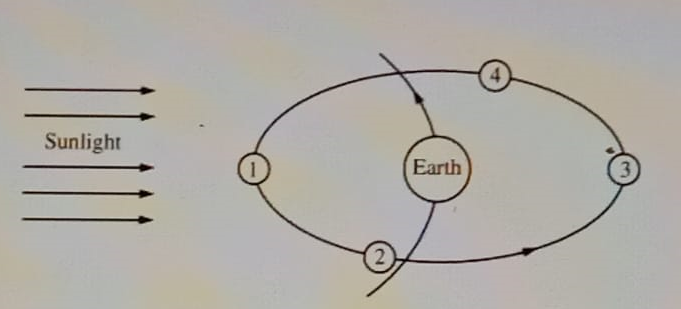
A full Moon will be observed from Earth when the Moon is located in Position 3.
A full Moon occurs when the Moon is directly opposite the Sun in relation to Earth, allowing the Sun's light to fully illuminate the Moon's surface as seen from our planet. This alignment is essential for the full Moon phase and is represented in Position 3 of the figure.
In Position 1, the Moon is located between the Sun and Earth, which results in a new Moon phase. During this position, the side of the Moon facing Earth is not illuminated by sunlight, making it invisible from our perspective.
Position 2 corresponds to the first quarter phase of the Moon, where half of the Moon is illuminated. In this alignment, the Moon is at a right angle to the line connecting the Earth and the Sun, thus only a portion of the Moon is visible, not a full Moon.
Position 3 is the correct answer. Here, the Moon is directly opposite the Sun, which allows the entire face of the Moon to be illuminated by sunlight as viewed from Earth. This is the defining characteristic of a full Moon.
Position 4 represents the third quarter phase, where the Moon again shows only half of its surface illuminated. Like the first quarter, this alignment is not conducive to observing a full Moon since it also involves the Moon being at a right angle to the Earth-Sun line.
The full Moon phase is achieved specifically when the Moon is positioned opposite the Sun, as illustrated in Position 3. Understanding Moon phases is critical for various fields, including astronomy and cultural practices, as the full Moon is often associated with significant events and rituals. Other positions do not provide the necessary alignment for a full Moon, showcasing how lunar visibility is directly tied to its position relative to both the Earth and the Sun.
Related Questions
View allWhich of the following involves a chemical change?
The selective breeding of plants and animals is called
The surface gravity on Mars is less than on Earth. Which property woul...
Which THREE of the following are examples of forces occurring in oppos...
Which of the following types of pathogen is responsible for the common...
Related Quizzes
View allPraxis 5001 Test with Answers
Praxis 5002 Study Guide
5002 Praxis Practice Test
Reading & Language Arts Praxis 5002
Praxis 5002 Reading and Language Arts Exam
Praxis 5003 Exam with Outline
5003 Praxis Math Answers
Praxis 5003 Study Guide
Praxis Social Studies 5004
Praxis 5004 Social Studies
- ✓ 500+ Practice Questions
- ✓ Detailed Explanations
- ✓ Progress Analytics
- ✓ Exam Simulations