
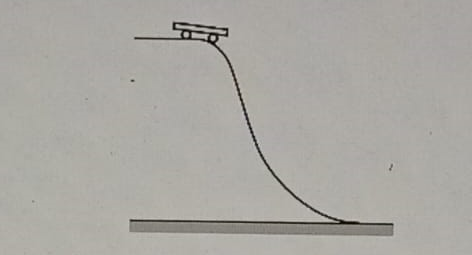
A cart is released from rest at the top of a hill and rolls to the bottom. In the absence of friction and air drag, the cart will have the highest kinetic energy at the
bottom of the hill
As the cart rolls down the hill, it converts gravitational potential energy into kinetic energy. At the bottom, all the potential energy has been transformed into kinetic energy, resulting in the highest speed and thus the maximum kinetic energy.
At the top of the hill, the cart has maximum potential energy and zero kinetic energy since it is initially at rest. Therefore, it cannot have the highest kinetic energy at this point, as there is no motion.
Just below the top of the hill, the cart will have started to convert some of its potential energy into kinetic energy, but it will still possess significant potential energy. Thus, the kinetic energy would not be at its maximum until the cart reaches the bottom.
At the midpoint of the hill, the cart has converted some of its potential energy into kinetic energy, but not all of it. The cart's kinetic energy would be greater than at the top but still less than at the bottom, where all potential energy has been converted.
At the bottom of the hill, the cart has converted all its initial potential energy into kinetic energy, reaching its maximum speed. This results in the highest kinetic energy, as there is no remaining potential energy.
The conversion of gravitational potential energy into kinetic energy means that as the cart descends, its speed—and therefore its kinetic energy—increases. The bottom of the hill is where this transformation is complete, resulting in maximum kinetic energy. Understanding this principle is fundamental in physics, particularly in energy conservation and motion dynamics.
Related Questions
View allWater stored in aquifers is found in which of the following locations?
In humans, gametes are produced by which of the following?
Which of the following statements is best supported by the data?
The space outside the nucleus of an atom normally contains which of th...
Which of the following best explains the observation that currents of...
Related Quizzes
View allPraxis 5001 Test with Answers
Praxis 5002 Study Guide
5002 Praxis Practice Test
Reading & Language Arts Praxis 5002
Praxis 5002 Reading and Language Arts Exam
Praxis 5003 Exam with Outline
5003 Praxis Math Answers
Praxis 5003 Study Guide
Praxis Social Studies 5004
Praxis 5004 Social Studies
- ✓ 500+ Practice Questions
- ✓ Detailed Explanations
- ✓ Progress Analytics
- ✓ Exam Simulations