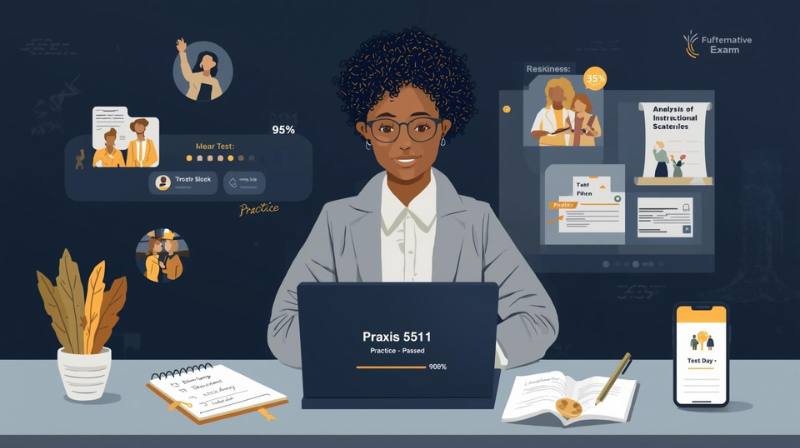
Teacher Certification Prep
The Praxis 5511, officially known as the Principles of Learning and Teaching: Grades 7–12 examination, is a critical requirement for teacher certification in many states across the country. This exam measures the pedagogical knowledge and professional judgment necessary for success in secondary education classrooms. Aspiring educators preparing for their licensure must demonstrate not only an understanding of teaching theory but also the ability to apply it in real-world instructional settings. The question many candidates ask is whether the Praxis 5511 is hard to pass. The answer depends on preparation, consistency, and the quality of study resources used. With the right approach, the Praxis 5511 is a manageable and achievable milestone on the path to becoming a certified teacher.
Exam Structure and Time Allocation for Praxis 5511
The Praxis 5511 is a computer-delivered assessment with a total testing time of two hours. It consists of two primary components: selected-response questions and constructed-response prompts. The first section includes seventy multiple-choice items that evaluate a candidate’s ability to interpret classroom scenarios, apply instructional strategies, and make data-informed decisions. These questions are rooted in authentic teaching experiences and require more than memorization, they demand practical application. The second component features four written responses, three of which are based on detailed classroom situations. Each scenario is followed by a prompt that requires a well-structured, evidence-based analysis. These constructed responses are scored using a detailed rubric that rewards clarity, specificity, and alignment with established educational frameworks. Mastery of both sections is essential to achieving a passing score on the Praxis 5511.
Content Domains and Their Significance in Praxis 5511
The examination evaluates competency across five core areas, each contributing a specific percentage to the final result. Students as Learners accounts for twenty percent of the test and focuses on cognitive development, motivation, diversity, learning styles, and individual differences such as disabilities and language acquisition. Instructional Process represents twenty-four percent and covers lesson planning, differentiation, scaffolding techniques, use of technology, and formative assessment practices. Assessment contributes sixteen percent and assesses knowledge of formal and informal evaluation methods, grading systems, data interpretation, and feedback delivery. Professional Development, Leadership, and Community makes up twelve percent and includes collaboration with colleagues, communication with families, ethical conduct, and engagement in lifelong learning. The Analysis of Instructional Scenarios category carries the highest weight at twenty-eight percent and is assessed entirely through the constructed-response section. This portion directly reflects the expectations of the Praxis 5511, requiring candidates to analyze complex teaching dilemmas and recommend effective, research-supported solutions.
Why Many Candidates Struggle
Several factors contribute to the difficulty some examinees experience with the Praxis 5511. Unlike exams that reward rote recall, this assessment emphasizes higher-order thinking and decision-making under pressure. Questions are framed around realistic classroom challenges, requiring candidates to select the most appropriate instructional response among several plausible options. Time management is another significant challenge, as candidates must balance accuracy with efficiency across both question types. The constructed-response section is particularly demanding, as answers must be clearly organized, directly address the prompt, and include concrete references to teaching principles. Responses that are vague or overly general typically receive low scores, even if they contain accurate information. Without structured practice and exposure to scenario-based questioning, many candidates find themselves unprepared for the rigor of the actual exam.
How to Prepare with Confidence
Success on the Praxis 5511 is not determined by chance but by consistent, high-quality preparation. Candidates should begin with a diagnostic assessment to identify strengths and areas needing improvement. Based on those results, a focused study plan spanning four to six weeks should be developed, with daily time dedicated to reviewing key concepts and practicing test-style questions. Topics such as differentiated instruction, Bloom’s Taxonomy, Maslow’s Hierarchy of Needs, and classroom management models must be thoroughly understood and applied. Poker Exams offers a comprehensive preparation platform aligned with the official ETS blueprint. The system includes hundreds of realistic selected-response questions, each accompanied by detailed explanations that clarify correct and incorrect choices. Full-length practice tests simulate the actual testing environment, helping candidates build endurance and improve pacing. The constructed-response module provides scored writing assignments modeled after official exam prompts, complete with scoring rationales and model answers. Performance tracking tools allow users to monitor progress and adjust focus areas over time. Mobile accessibility ensures flexibility, enabling study during breaks, commutes, or after work hours.
Pass the Praxis 5511 with Confidence and Start Teaching
Your journey to becoming a licensed educator culminates in passing the Praxis 5511 with confidence and competence. With the right resources, a disciplined study plan, and realistic practice, you can master both the multiple-choice and constructed-response sections of the exam. Poker Exams delivers the proven, expert-backed preparation system trusted by thousands of future teachers. From scenario-based questions to performance analytics, we provide everything you need to succeed. Do not leave your certification to chance. Begin your preparation today and take the decisive step toward earning your license and stepping into the classroom as a qualified, capable professional.