Facing a math test can feel like a return to a dreaded high school classroom, complete with confusing formulas and abstract equations. But if you’re preparing to take the Missouri HiSET Math test, you should know that this exam isn’t just about numbers; it’s about a unique and practical approach to problem-solving. This test has its own personality, and understanding its quirks can give you a significant advantage. This guide will walk you through five essential and often overlooked features of the Missouri HiSET Math test that can make all the difference in your preparation and on test day.
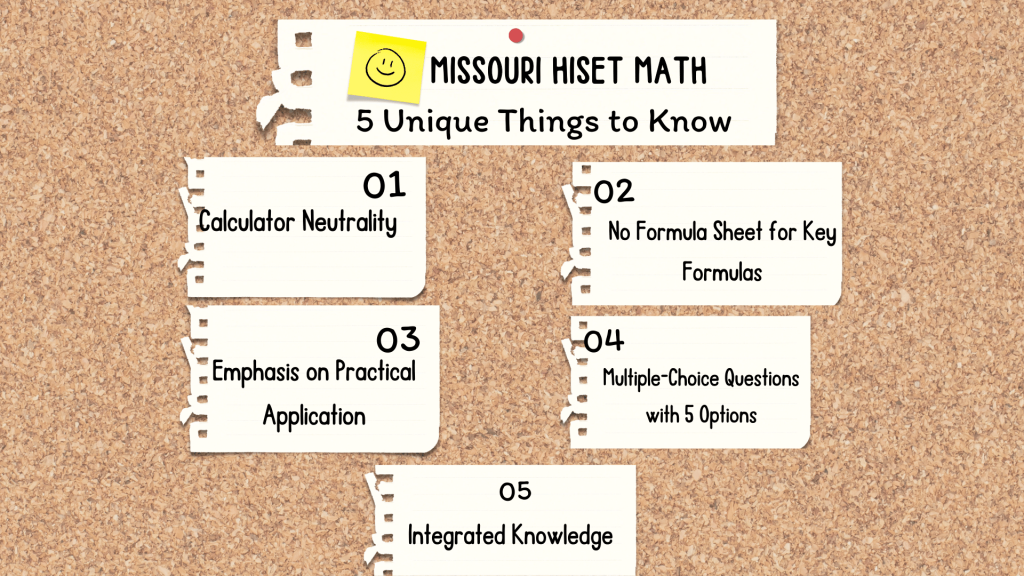
1. Calculator Neutrality
One of the most surprising things about the Missouri HiSET Math test is that while a calculator is provided, you don’t always need it. The test is designed to be “calculator neutral,” meaning many of the questions can be solved more quickly and efficiently with mental math or basic calculations than by punching numbers into a machine. The specific calculator provided is the Casio-cfx260 scientific calculator. While it’s a powerful tool, relying on it for every problem can slow you down, especially when you have a limited amount of time. Instead, the test rewards strong foundational math skills. This unique feature of the Missouri HiSET emphasizes a deep understanding of concepts rather than just the ability to use a tool. By practicing problems without a calculator, you can build the confidence to solve them on your own, reserving the calculator for truly complex operations like square roots or intricate fractions. This approach will help you maintain a faster pace and manage your time effectively on the Missouri HiSET Math test.
2. No Formula Sheet for Key Formulas
It’s a common misconception that all the formulas you might need will be given to you on a test. While the Missouri HiSET does provide a formula sheet with some helpful geometric formulas for area and volume, it deliberately omits some of the most critical ones you’ll need. This is a crucial detail that can catch test-takers off guard. You must memorize and be able to apply key formulas such as the Pythagorean Theorem (a^2+b^2=c^2), the distance formula (d=sqrt(x2−x1)^2+(y2−y1)^2), and the quadratic formula (x=(−b±sqrt(b^2-4ac))/2a
). These are not provided on the test and are essential for solving a significant number of geometry and algebra problems. Failing to know them could mean losing easy points. To prepare for the Missouri HiSET Math test, make flashcards or use mnemonic devices to commit these fundamental formulas to memory. Practice writing them out until they become second nature.
3. Emphasis on Practical Application
Unlike traditional math classes that might focus on abstract theory, the Missouri HiSET Math test is all about practical, real-world application. The questions are rarely presented as simple equations. Instead, they are framed as word problems that require you to identify the underlying math concept and apply it to a realistic scenario. You might be asked to calculate the amount of paint needed to cover a wall, figure out a car’s gas mileage for a road trip, or interpret a sales report to find the average profit. This approach is designed to test your ability to think like a professional in a real-world setting. To prepare for the Missouri HiSET Math test, don’t just solve equations. Practice with word problems from various sources—online practice tests, study guides, and even everyday situations. Train your brain to identify keywords and translate a narrative into a mathematical problem you can solve.
4. Multiple-Choice Questions with 5 Options
While it may seem like a small detail, the Missouri HiSET Math test has five answer choices for each multiple-choice question, unlike many other standardized tests that typically have only four. This small difference can have a big impact. With an extra option, the probability of guessing the correct answer drops, placing a greater emphasis on having a solid understanding of the material. This isn’t a test where you can rely on luck; it requires a confident, reasoned approach to each question. This format of the Missouri HiSET forces you to be more deliberate with your process of elimination. Instead of simply ruling out two choices, you may need to evaluate three incorrect answers before arriving at the correct one. It’s a subtle but important feature of the Missouri HiSET that reinforces the need for thorough preparation and confidence in your problem-solving skills.
5. Integrated Knowledge
The final unique aspect of the Missouri HiSET Math test is its tendency to integrate multiple mathematical concepts into a single problem. You won’t just get a simple algebra question or a straightforward geometry problem. Instead, you might find a question that requires you to use both geometry and algebra to solve it, or one that combines data analysis with percentages. For example, a question might ask you to find the perimeter of a shape that is drawn on a coordinate plane, forcing you to use the distance formula (from algebra) to find the length of each side before adding them all up (from geometry). This approach tests your ability to see how different areas of math are interconnected and to apply multi-step reasoning. To excel on the Missouri HiSET Math test, practice with complex, multi-step problems and get comfortable with seeing how different mathematical concepts can be used in combination to find a single solution.
By understanding these five unique features of the Missouri HiSET Math test, you can go beyond basic studying and create a preparation strategy that is truly tailored for success. Focus on memorizing key formulas, practicing practical word problems, and getting comfortable with multi-step questions. These insights are your key to acing the exam and moving forward with your goals.
Pingback: Mastering the HiSET Math Practice Test: Approach to Success
Comments are closed.